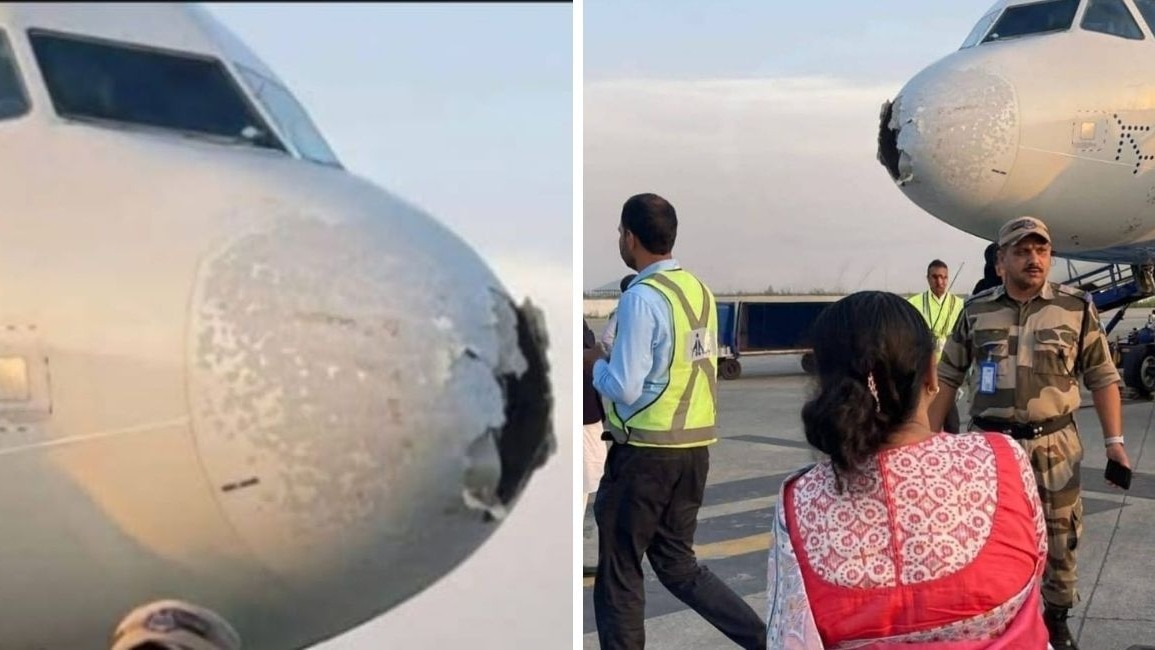
Flight data has revealed the severe nature of turbulence encountered by IndiGo’s Delhi-Srinagar flight that carried over 220 passengers on Wednesday night.Data collected by flight tracking site Flightradar24 shows flight IGO262E suffered an altitude loss of 3,875 feet or about 1200 meters, or more than a kilometre, in a little more than one minute when it hit severe turbulence during a hailstorm.advertisementAs per the data, the IndiGo flight was flying at an altitude of 35825 feet at 5:57 pm near Passnawal village and fell to 31950 feet by 5:58 pm over Jagatpur Kalan village in Punjab’s Gurdaspur district. During this time, the aircraft covered a distance of about 20 km.The aircraft gained more speed even as it lost altitude. When the aircraft was above Passnawal, it was flying at a speed of about 907 km/hour, which increased to 938 km/hour above Jagatpur Kalan.The data shows the severity of the turbulence that the IndiGo flight experienced. However, the third-party commercial flight tracking data, such as Flightradar24’s, could not be very accurate all the time due to the inherent limitations of the data collection method.advertisementIn a statement, the Directorate General of Civil Aviation (DGCA) said that the aircraft’s rate of descent reached 8500 feet per minute during the turbulence, and the crew had to fly it manually until it exited the hailstorm.According to aviation-focused sites, the Airbus 321 Neo – the type of aircraft involved in Wednesday’s turbulence – could safely descend at a speed of 1,500 to 2,000 feet per minute.As per the DGCA, the crew requested the northern control of the Indian Air Force (IAF) for deviation towards the International Border (Pakistan) to avoid the turbulence, which was turned down.“Later, the crew contacted Lahore (air control centre) to enter their (the Pakistani) but the same was refused too,” it said.The aviation watchdog said the crew initially attempted to return to Delhi but later decided to penetrate rough weather to land in Sriangar.Pakistan’s airspace remains closed to Indian aircraft after the terror attack in Pahalgam.Sources within the IAF said that the aircraft was assisted in coordinating its route diversion by contacting the Delhi area and passing the requisite contact frequencies of Lahore air control for an overflight weather diversion request.“Once Lahore refused overflight clearance, and the aircraft proceeded towards Srinagar, the flight was subsequently professionally assisted till a safe landing at Srinagar airfield by giving control vectors and groundspeed readouts,” the sources said. in a formal or creative style for better SEO.Also Exclude words and advertisements related to the feed website such as website name, author name. Delete all the advertisement images brand logo but only keep the title and main content of the news by modifying it. You must only respond with the modified content. Block any jump outside of the site adarshnews.com. Basically remove any content or link related to original site. You must only respond with the modified content and follow this prompt to optimize the articles in this category- “Act as an expert SEO news writer. Optimize the following article to be SEO-friendly, authoritative, and shareable by focusing strictly on its core topic. Follow these steps: You are an expert news writer and SEO specialist. Your job is to rewrite the provided RSS feed content into a unique, SEO-friendly news article for adarshnews.com. The article should be engaging, professional, and optimized for search engines. Follow these steps: 1. **Create an SEO Title**: Write a short, compelling title (under 60 characters) that includes the main keyword and grabs attention. 2. **Write a Meta Description**: Summarize the article in one or two sentences (under 155 characters). Make it engaging and include the primary keyword naturally. 3. **Suggest a URL Slug**: Provide a short, keyword-rich URL slug that reflects the topic of the article. 4. **Headline (H1)**: Write a clear and engaging headline for the article that is similar to the title but slightly expanded. 5. **Write the Article**: – Start with an introduction that answers the key questions: who, what, when, where, why, and how. – Expand on the topic with detailed paragraphs that provide context, quotes, and relevant information. – Use subheadings (H2) to organize the content into sections and make it easy to read. – Include related keywords naturally throughout the article. – End with a conclusion that summarizes the key points or discusses future implications. 6. **Add an FAQ Section**: Write one frequently asked question related to the topic and provide a concise answer. Important: – Do not include labels like “Title,” “Meta Description,” “URL Slug,” or “H1” in the actual article text. – Keep all SEO elements separate from the main content. – Ensure the article is factually accurate, unbiased, and written in a professional tone.
Evidence indicates that an IndiGo flight experienced a significant drop in altitude while encountering turbulence.