**Bitcoin Price Surges Near $94,000 Amid Institutional Demand**
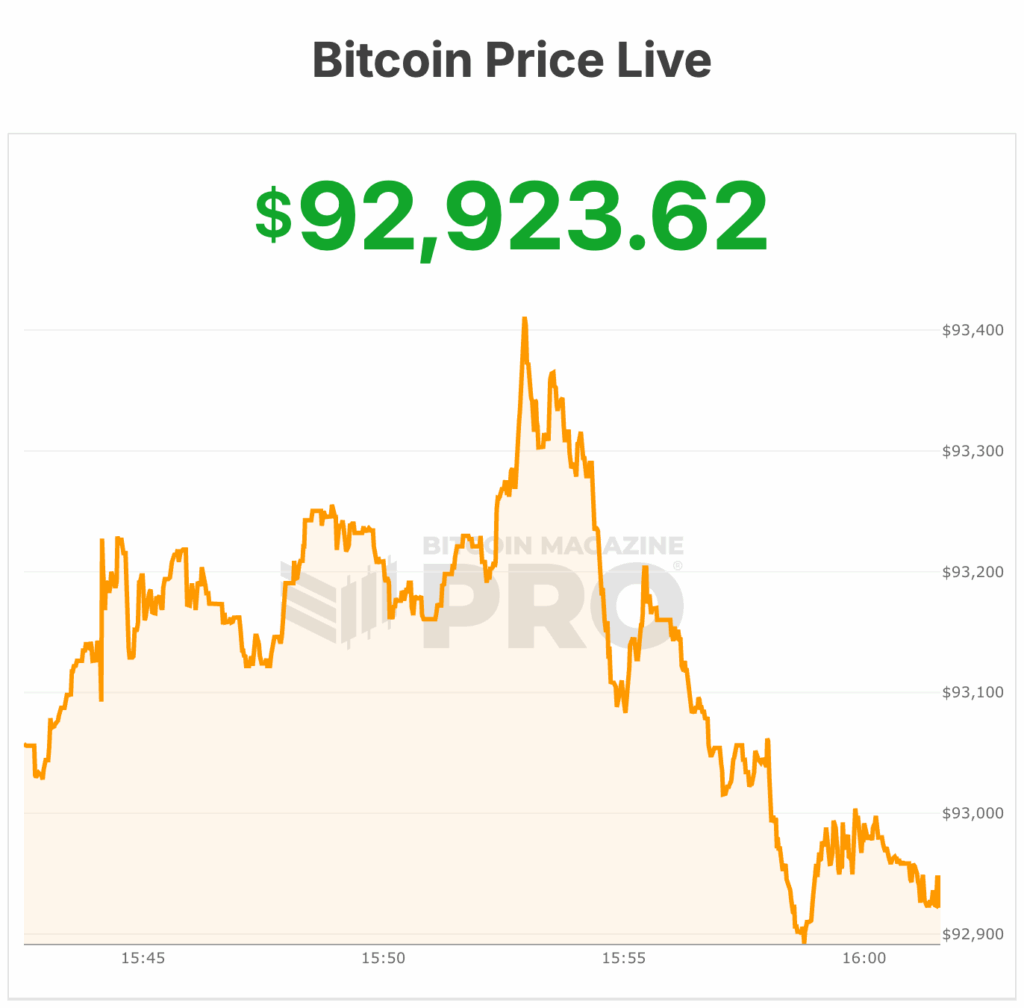
Bitcoin’s price is currently hovering around $93,000, with approximately $81 billion traded in the last 24 hours. The cryptocurrency has seen a 3% increase today, just 1% shy of its daily peak of $93,929 and about 3% above the weekly low of $90,837. With nearly 19.96 million BTC in circulation, Bitcoin is approaching its capped supply of 21 million. This recent price movement has elevated Bitcoin’s global market capitalization to $1.86 trillion, also reflecting a 3% rise during the same timeframe.
Analysts note that Bitcoin’s price briefly dipped below its Metcalfe-based fair value for the first time in 2023, indicating what they describe as a classic late-cycle reset. This shift occurred following a significant 36% decline that brought Bitcoin’s price close to $80,000 last week, effectively eliminating excess leverage and liquidating speculative positions. Network economist Timothy Peterson highlights that historical trends show strong future returns when Bitcoin trades below its fundamental network value, with average gains of 132% over the past twelve months and positive performance occurring 96% of the time, as reported by CoinDesk.
The dynamics within the Bitcoin network are also evolving. Long-term holders have accumulated approximately 50,000 BTC over the past ten days, reversing a trend of steady distribution. This transition from short-term traders to long-term storage is reducing selling pressure at a critical time when Bitcoin is striving to regain higher price levels. Bitcoin managed to recover above $90,000 this week, reaching highs of $93,978 on Wednesday.
**Macro Conditions and Bitcoin’s Future**
Current macroeconomic conditions are aligning with on-chain signals. The Federal Reserve has concluded its Quantitative Tightening, with markets anticipating a near-certain rate cut in December. Historically, reversals in QT have coincided with significant Bitcoin rallies, a pattern observed since 2010, including the explosive cycles of 2013 and the post-2019 surge that propelled Bitcoin to $67,000.
Business-cycle indicators are also showing signs of change. The copper-to-gold ratio, a leading indicator for U.S. manufacturing sentiment and future PMI strength, appears to be bottoming out. Bitcoin’s recent stagnation, despite increasing global liquidity, suggests that investors are responding more to declining economic confidence than to crypto-specific factors. A resurgence in risk appetite could potentially benefit Bitcoin after a prolonged period of consolidation.
However, the short-term outlook remains precarious. A bearish close in November confirmed a monthly MACD cross, a signal that often precedes extended periods of reduced momentum. Key support levels around $85,000 and $84,000 are being closely monitored, as a breakdown could lead to a deeper test of $75,000. Despite being significantly down from its record high of $126,000 set in October, Bitcoin’s volatility has decreased as liquidations have subsided. Institutional interest continues to grow, even amidst market turbulence.
**FAQ**
**What factors are currently influencing Bitcoin’s price?**
Bitcoin’s price is influenced by a combination of institutional demand, macroeconomic conditions, and shifts in market sentiment. Recent trends indicate a recovery in long-term holding and a potential increase in risk appetite among investors.