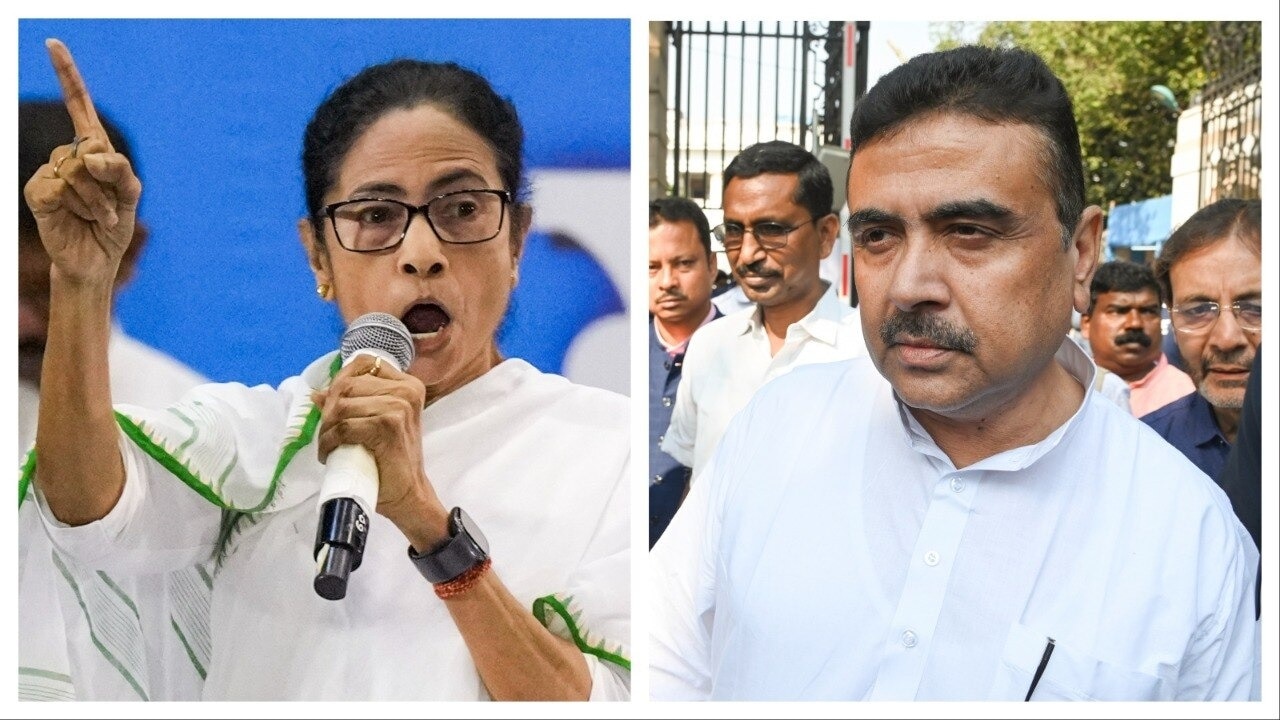
Chief Minister Mamata Banerjee’s Bhabanipur constituency has recorded one of the highest voter deletions in West Bengal, logging nearly four times more removals than Opposition Leader Suvendu Adhikari’s Nandigram, according to constituency-wise data released by the Election Commission (EC) on Friday.The Election Commission released the figures a day after the deadline for submitting enumeration forms under the Special Intensive Revision (SIR) process ended, revealing significant variations across the state and adding a fresh political edge ahead of next week’s draft rolls.advertisementData showed that Bhabanipur in south Kolkata, widely regarded as Banerjee’s pocket borough, recorded 44,787 deletions from the 2,06,295 voters listed in January 2025, while Nandigram, the crucible of the anti-land acquisition movement that propelled the TMC to power in 2011 and stronghold of Adhikari, saw 10,599 deletions from 2,78,212 voters.The commission has classified the deletions under standard categories such as deaths, relocation, untraceable addresses and duplicate entries.Officials maintained the process followed uniform criteria statewide.Despite the political attention on Bhabanipur, it was not the constituency with the highest number of deletions.Among the state’s 294 Assembly constituencies, the highest number of deletions occurred in north Kolkata’s Chowringhee represented by TMC MLA Nayana Bandyopadhyay, which saw 74,553 voters struck off the rolls. A three-time MLA, she had won the seat by a margin of more than 44,000 votes in 2021.Kolkata Port, represented by senior minister and Mayor Firhad Hakim, logged 63,730 deletions.Hakim, a three-time MLA, had won the seat by a margin of around 70,000 votes, a factor that cemented his grip over the constituency.In Tollygunge, held by minister Aroop Biswas, 35,309 names were removed.Biswas, a four-time MLA, had retained the seat in 2021 with a margin of about 50,000 votes, underscoring his organisational control over one of Kolkata’s most politically crucial belts.In constituencies held by key BJP legislators, deletion numbers were higher than Nandigram but lower than Kolkata Port.Asansol South, represented by Agnimitra Paul, recorded 39,202 deletions.Paul had won the seat by a slender margin of barely 4,000 votes, making it one of the BJP’s closest-fought victories in the 2021 Assembly elections.Siliguri, represented by Shankar Ghosh, reported 31,181 deletions.Ghosh, a former CPI(M) leader who switched to the BJP ahead of the 2021 polls, had captured the Siliguri seat with a margin of over 35,000 votes, marking one of the BJP’s most significant breakthroughs in north Bengal.In Behala West, represented by suspended TMC MLA Partha Chatterjee, 52,247 names were removed, while neighbouring Behala East, held by Ratna Chatterjee, saw 53,036 deletions.advertisementIn Shyampukur, represented by minister Shashi Panja, there were 42,303 deletions, while Ballygunge, represented by minister Babul Supriyo, the former BJP in a formal or creative style for better SEO.Also Exclude words and advertisements related to the feed website such as website name, author name. Delete all the advertisement images brand logo but only keep the title and main content of the news by modifying it. You must only respond with the modified content. Block any jump outside of the site adarshnews.com. Basically remove any content or link related to original site. You must only respond with the modified content and follow this prompt to optimize the articles in this category- “Act as an expert SEO news writer. Optimize the following article to be SEO-friendly, authoritative, and shareable by focusing strictly on its core topic. Follow these steps: You are an expert news writer and SEO specialist. Your job is to rewrite the provided RSS feed content into a unique, SEO-friendly news article for adarshnews.com. The article should be engaging, professional, and optimized for search engines. Follow these steps: 1. **Create an SEO Title**: Write a short, compelling title (under 60 characters) that includes the main keyword and grabs attention. 2. **Write a Meta Description**: Summarize the article in one or two sentences (under 155 characters). Make it engaging and include the primary keyword naturally. 3. **Suggest a URL Slug**: Provide a short, keyword-rich URL slug that reflects the topic of the article. 4. **Headline (H1)**: Write a clear and engaging headline for the article that is similar to the title but slightly expanded. 5. **Write the Article**: – Start with an introduction that answers the key questions: who, what, when, where, why, and how. – Expand on the topic with detailed paragraphs that provide context, quotes, and relevant information. – Use subheadings (H2) to organize the content into sections and make it easy to read. – Include related keywords naturally throughout the article. – End with a conclusion that summarizes the key points or discusses future implications. 6. **Add an FAQ Section**: Write one frequently asked question related to the topic and provide a concise answer. Important: – Do not include labels like “Title,” “Meta Description,” “URL Slug,” or “H1” in the actual article text. – Keep all SEO elements separate from the main content. – Ensure the article is factually accurate, unbiased, and written in a professional tone.
Mamata Banerjee’s constituency has 4 times more voter deletions than Suvendu Adhikari’s stronghold.