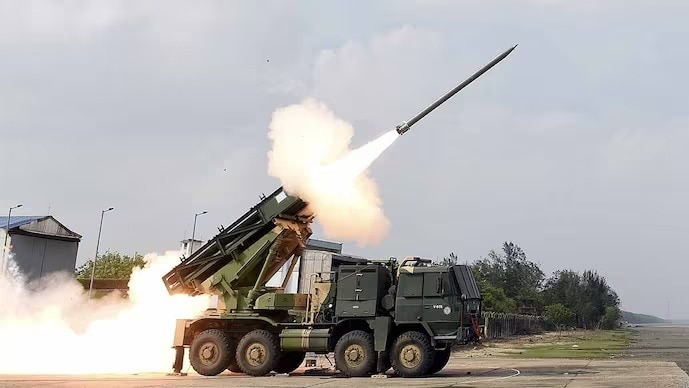
In a major push to strengthen India’s long-range strike capabilities and expand its artillery arsenal, the Army has moved a proposal worth around Rs 2,500 crore to induct 120-km strike-range Pinaka rockets. The project, aimed at significantly enhancing the reach and lethality of the indigenous Pinaka multi-barrel rocket launcher system, is expected to be taken up for approval by the Defence Acquisition Council (DAC) soon, according to senior defence officials.advertisementThe new rockets will be developed by the Defence Research and Development Organisation (DRDO), which is already in the advanced stages of creating the extended-range variant.Originally built with a 37.5 km range, the Pinaka has been upgraded over time to deliver greater range and effectiveness.Officials said the first trials are planned for the near future, after which the system will be co-developed with selected Development-cum-Production Partners (DcPPs) under a competitive bidding process.“The 120-km rockets will be compatible with existing Pinaka launchers, which currently fire rockets with ranges of 40 km and over 75 km,” officials noted, adding that the upgrade will give the Army a substantial edge in precision, responsiveness, and battlefield depth.The push for the long-range Pinaka comes amid the Army’s broader effort to augment its artillery strength following Operation Sindoor.The service has already begun reinforcing its existing Pinaka regiments, recently placing orders for area denial munitions and enhanced high-explosive rockets.Earlier this year, the Defence Ministry signed contracts worth Rs 10,147 crore with Economic Explosives Limited (EEL) and Munitions India Limited (MIL) for procuring DPICM Area Denial Munition Type-1 and High Explosive Pre-Fragmented Mk-1 (Enhanced) rockets.Additionally, the Ministry concluded an agreement with Bharat Electronics Limited (BEL) for upgrades to the SHAKTI fire-control software, further improving the system’s operational effectiveness. Defence Secretary Rajesh Kumar Singh was present during the signing of the contracts.A DRDO official confirmed that the 120-km Pinaka version is slated for its first test in the next financial year, marking a crucial milestone in India’s ongoing drive toward defence indigenisation.The Pinaka, developed by DRDO and produced through Indian industry partners, has emerged as one of India’s major defence export successes.The system has already been supplied to Armenia, and officials say several European nations, including France, have expressed interest.Army Chief General Upendra Dwivedi has strongly backed the expanded Pinaka programme, stating that once long-range versions are operational, the Army may “drop plans for other alternate systems,” underscoring the service’s confidence in the indigenous platform.advertisementWith the new proposal, the Ministry of Defence continues its push toward boosting self-reliance while equipping the Army with modern, high-precision, long-range str in a formal or creative style for better SEO.Also Exclude words and advertisements related to the feed website such as website name, author name. Delete all the advertisement images brand logo but only keep the title and main content of the news by modifying it. You must only respond with the modified content. Block any jump outside of the site adarshnews.com. Basically remove any content or link related to original site. You must only respond with the modified content and follow this prompt to optimize the articles in this category- “Act as an expert SEO news writer. Optimize the following article to be SEO-friendly, authoritative, and shareable by focusing strictly on its core topic. Follow these steps: You are an expert news writer and SEO specialist. Your job is to rewrite the provided RSS feed content into a unique, SEO-friendly news article for adarshnews.com. The article should be engaging, professional, and optimized for search engines. Follow these steps: 1. **Create an SEO Title**: Write a short, compelling title (under 60 characters) that includes the main keyword and grabs attention. 2. **Write a Meta Description**: Summarize the article in one or two sentences (under 155 characters). Make it engaging and include the primary keyword naturally. 3. **Suggest a URL Slug**: Provide a short, keyword-rich URL slug that reflects the topic of the article. 4. **Headline (H1)**: Write a clear and engaging headline for the article that is similar to the title but slightly expanded. 5. **Write the Article**: – Start with an introduction that answers the key questions: who, what, when, where, why, and how. – Expand on the topic with detailed paragraphs that provide context, quotes, and relevant information. – Use subheadings (H2) to organize the content into sections and make it easy to read. – Include related keywords naturally throughout the article. – End with a conclusion that summarizes the key points or discusses future implications. 6. **Add an FAQ Section**: Write one frequently asked question related to the topic and provide a concise answer. Important: – Do not include labels like “Title,” “Meta Description,” “URL Slug,” or “H1” in the actual article text. – Keep all SEO elements separate from the main content. – Ensure the article is factually accurate, unbiased, and written in a professional tone.
Indian Army to procure long-range Pinaka rockets from DRDO for Rs 2,500 crore