**Title:** Did DOJ Violate Executive Order by Selling Samourai Wallet Bitcoin?
**Meta Description:** The DOJ’s sale of forfeited Samourai Wallet bitcoin raises questions about compliance with Executive Order 14233.
**URL Slug:** doj-samourai-wallet-bitcoin-sale
**Headline:** Did the DOJ Breach Executive Order 14233 by Selling Samourai Wallet Bitcoin?
The U.S. Marshals Service (USMS) has reportedly sold approximately $6.3 million worth of bitcoin that was forfeited by Samourai Wallet developers Keonne Rodriguez and William Lonergan Hill as part of their guilty plea. This action may have violated Executive Order (EO) 14233, which stipulates that bitcoin obtained through criminal or civil asset forfeiture should be retained as part of the United States’ Strategy Bitcoin Reserve (SBR). If the Southern District of New York (SDNY) indeed contravened EO 14233, it would not be the first instance of SDNY employees disregarding federal directives.
**What Happened to the Bitcoin?**
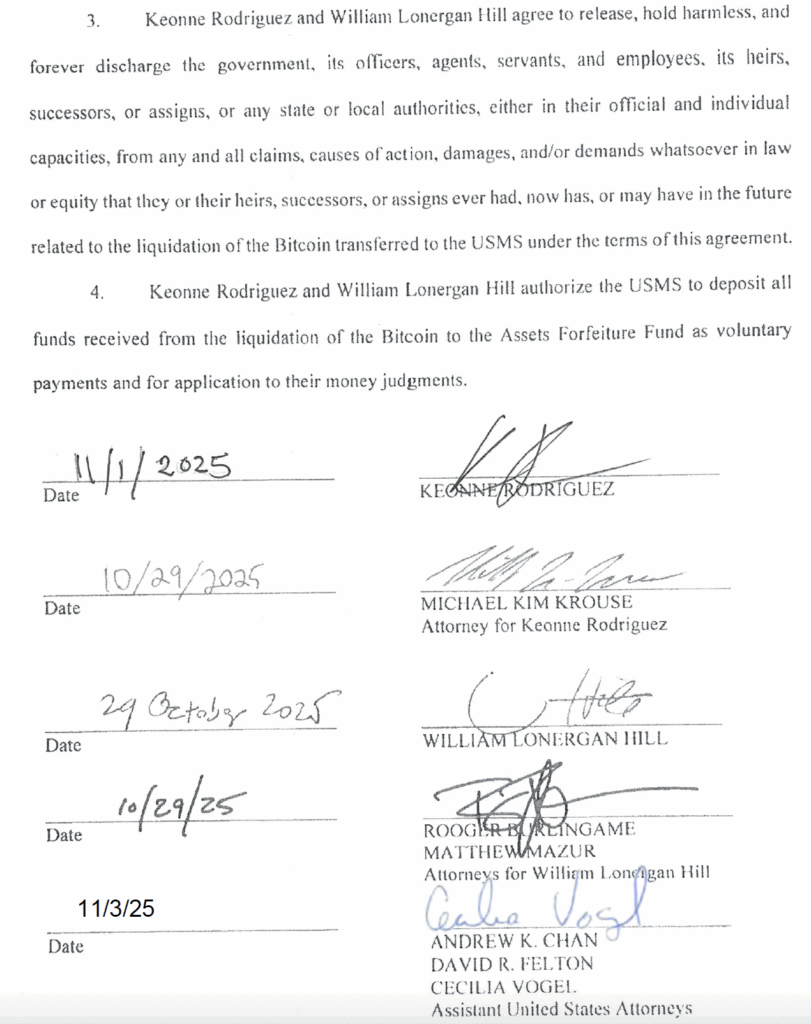
A document titled “Asset Liquidation Agreement,” recently obtained, reveals that the bitcoin forfeited by Rodriguez and Hill was either sold or is set to be sold. According to this document, the defendants agreed to transfer $6,367,139.69 worth of bitcoin—equivalent to 57.55353033 bitcoin at the time of the agreement’s final signature on November 3, 2025, by Assistant U.S. Attorney Cecilia Vogel—to the USMS. The bitcoin was transferred from a specific address on the same date, seemingly bypassing direct custody by the USMS and instead being sent directly to a Coinbase Prime address, which currently shows a zero balance, suggesting that the bitcoin may have already been liquidated.
**Potential Violation of Executive Order 14233**
If the USMS has indeed sold the forfeited bitcoin, it likely contradicts EO 14233, which mandates that bitcoin acquired through criminal forfeiture—referred to as “Government BTC”—“shall not be sold” and should be added to the U.S. SBR. The sale of the bitcoin by the USMS would indicate that certain DOJ members may still perceive bitcoin as a liability rather than a strategic asset, contrary to President Trump’s directive for government agencies to retain such assets. Given that the Samourai prosecution began under a previous administration known for its antagonism toward noncustodial crypto tools, the decision to disregard EO 14233 aligns with a broader trend of treating bitcoin as an asset to be divested quickly.
**Legal Context of the Forfeiture and Liquidation**
The legal implications surrounding the forfeiture and subsequent liquidation of the bitcoin raise significant questions about compliance with federal directives. The actions taken by the USMS could set a precedent for how similar cases are handled in the future, particularly regarding the treatment of cryptocurrency assets acquired through legal proceedings.
**Conclusion**
The sale of the forfeited Samourai Wallet bitcoin by the USMS may represent a significant breach of Executive Order 14233, highlighting ongoing tensions within federal agencies regarding the management of cryptocurrency assets. As the legal landscape surrounding digital currencies continues to evolve, the implications of this case could resonate throughout future asset forfeiture proceedings.
**FAQ**
**Q: What is Executive Order 14233?**
A: Executive Order 14233 mandates that bitcoin acquired through criminal or civil asset forfeiture must be retained as part of the U.S. Strategy Bitcoin Reserve and should not be sold.