**Title:** Tensions Rise at Supreme Court Over Transgender Athlete Case
**Meta Description:** A heated protest unfolded outside the Supreme Court as arguments were made regarding a lawsuit involving transgender athlete Lindsay Hecox.
**URL Slug:** tensions-supreme-court-transgender-athlete-case
—
**Tensions Rise at Supreme Court Over Transgender Athlete Case**
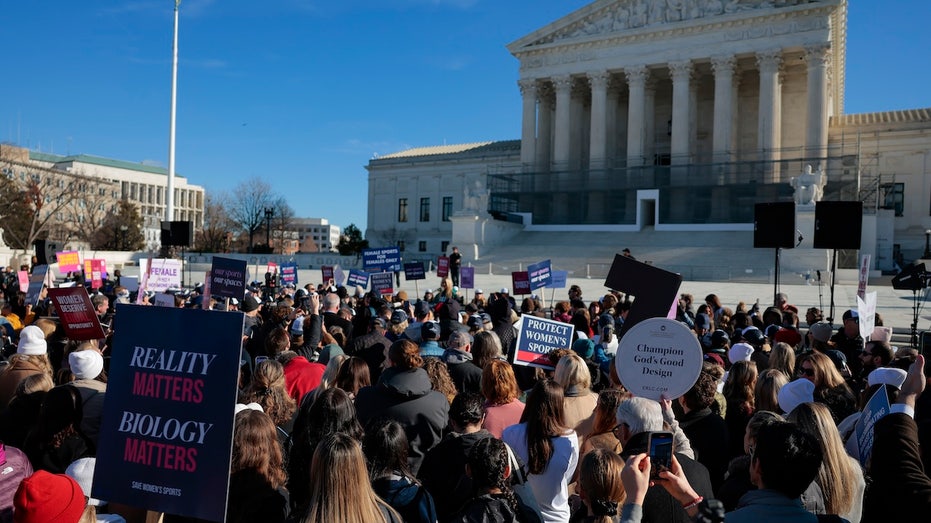
A dramatic scene unfolded outside the U.S. Supreme Court on Tuesday, where trained military snipers were stationed on the roof as a clash of ideologies took place below. An alliance of women wearing shirts emblazoned with “XX-XY” faced off against a group of activists adorned in pink, white, and blue, some in elaborate costumes and others in minimal attire. The atmosphere grew intense, with cries of “Stop cutting off the breasts!” from one side, while the other countered with a relentless chant of “Trans! Trans! Trans!”
Inside the court, the legal team representing transgender athlete Lindsay Hecox sought to have their original lawsuit, Hecox v. Little, dismissed as moot, given that it was under review by the Supreme Court. Filed in 2020, the lawsuit challenged Idaho’s law aimed at protecting women’s sports, allowing Hecox to compete on the women’s cross-country team at Boise State University.
In a pivotal moment for Hecox’s legal team, attorney Kathleen Hartnett acknowledged that Hecox was “unlikely” to graduate in May, contradicting earlier claims that her graduation would make a ruling on her athletic eligibility unnecessary. Hartnett stated, “She’s unlikely to graduate by May, but is hoping to earn summer credits to graduate in the fall.” This admission came just months after the firm suggested the case was moot, with Hecox previously asserting her enrollment in classes that could lead to a May 2026 graduation.
During the hearing, Idaho Solicitor General Alan Hurst challenged Hecox’s graduation timeline, labeling it “not possible” after the state conducted inquiries into her academic status. John Bursch, legal counsel for Alliance Defending Freedom, noted, “It just shows that throughout the case, Hecox has flipped back and forth.”
Idaho Attorney General Raul Labrador emphasized the importance of revealing this discrepancy, stating, “I think it’s important. I don’t think it’s the main issue in the case, but I think it’s important.” He pointed out that the argument could have been made earlier in the process but was only raised after the Supreme Court agreed to hear the case.
The plaintiffs faced further challenges during oral arguments in a related case involving a West Virginia transgender teen who also sought to block a state law restricting male participation in girls’ sports. ACLU attorney Joshua Block suggested that the definition of “sex” should remain ambiguous, adding another layer of complexity to the ongoing legal debates surrounding transgender rights in sports.
As the legal battles continue, the implications for transgender athletes and the future of women’s sports remain uncertain, highlighting the ongoing national discourse on these critical issues.
**FAQ**
**What is the main issue in the Hecox v. Little case?**
The case centers on whether transgender athletes can compete in sports corresponding to their gender identity, challenging state laws that aim to restrict such participation.