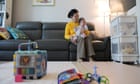
South Korea’s birthrate rose last year for the first time in nine years, as a surge in marriages raised hopes that the country may be lifting itself out of its demographic crisis.Preliminary data released by the government body Statistics Korea on Wednesday showed that the number of babies born per 1,000 people in 2024 stood at 4.7, the first rise since 2014.South Korea’s fertility rate – or the average number of babies a woman is expected to have in her lifetime – was 0.75, the data said, up 0.03 from 0.72 in 2023. The number of births last year was 238,300, an increase of 8,300, or 3.6%.While the country wrestles with a prolonged political crisis, government attempts to persuade more young people to marry and have children appear to have had a positive – if limited – effect.South Korea has one of the world’s longest life expectancies and its lowest birthrate – a combination experts have warned will lead to population instability and pose a threat to its status as a regional economic power.The rise in the birthrate has come from a very low base and remains far below the 2.1 births per woman needed to stabilise the population without large-scale immigration.Since 2018, South Korea has been the only OECD country with a rate below 1.0 – a level the government says it hopes to achieve by 2030.But it has struggled to tackle factors experts believe are behind the reluctance to have larger families, including the high cost of living and education, a tough job market and growing opposition among women to traditional gender roles.In response, the conservative administration of the impeached president, Yoon Suk Yeol, has spent billions of dollars on measures to arrest the decline, including financial incentives for newlyweds and expanded childcare assistance.Yoon, whose fate is now in the hands of the constitutional court following his short-lived declaration of martial law in December, has described the low birthrate as a “national crisis” and said he planned to create a new ministry to address it.Park Hyun-jung, an official from Statistics Korea, said the rise in the number of marriages seen after since the lifting of Covid-19 restrictions had continued.The number of marriages – considered a reliable indicator of expected births in a country where few children are born out of wedlock – jumped 14.9% last year, the biggest rise since data was first released in 1970.“There was a change in social values, with more positive views about marriage and childbirth,” Park told a briefing, adding that a rise in the number of people in their early 30s had also been a factor.“It is difficult to measure how much each factor contributed to the rise in new births, but they themselves had an impact on each other too,” she said.South Korea’s overall population is in decline, however, with deaths outstripping births by 120,000 last year – the fifth consecutive year of natural shrinkage.The population, which peaked at 51.83 million in 2
South Korea birthrate rises for first time in nine years amid surge in marriages