Authorities in Japan have issued warnings regarding the country’s largest wildfire in decades, which has already damaged numerous homes and forced over 1,000 residents to evacuate. The fires have been raging for a week in Ofunato, located on the northeast coast, with meteorological officials attributing the situation to an unusually dry winter and strong winds.
As of Monday, the wildfire had consumed approximately 2,100 hectares, damaged 84 homes, and led to 1,200 individuals seeking refuge in school gymnasiums and other shelters, while an additional 2,000 are staying with friends or family. Local officials suspect that the fire may have contributed to the death of a man whose body was found on a road in the city late last week.
Over 2,000 Self-Defense Force (SDF) troops and firefighters are working tirelessly to contain the flames, which are spreading through densely forested mountainous regions near Ofunato, a community previously affected by the March 2011 earthquake and tsunami. “The fire has significant force,” stated the city’s mayor, Kiyoshi Fuchigami, expressing concerns about its potential to spread further.
Prime Minister Shigeru Ishiba has pledged to deploy as many firefighters and SDF personnel as needed to mitigate the damage. “While it is likely that the fire will spread to some extent, we will take all possible measures to protect people’s homes,” he assured lawmakers.
Relief may be on the horizon, as the meteorological agency forecasts snowfall beginning early Wednesday, transitioning to rain by noon.
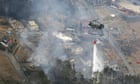
Four days after the fire ignited, aerial footage from NHK revealed the charred remains of buildings, with flames and thick smoke billowing from other structures in the most affected neighborhoods of Ofunato, a city of around 40,000 residents located 500 km north of Tokyo. This wildfire is the most significant in Japan since the late 1980s, according to the fire and disaster management agency. While other regions, including mountainous Nagano prefecture, have experienced fires this winter, those have been brought under control.
Northeast Japan is facing its driest winter since record-keeping began in 1946, with Ofunato receiving only 2.5mm of rainfall in February, compared to an average of 41mm for that month in previous years. “The weather conditions are dry, winds are strong, and the terrain is steep,” explained Yoshiya Touge, a professor of water resource research at Kyoto University. “Additionally, many of the trees, particularly conifers, are highly flammable, which accelerates the fire’s spread.”
Although the number of wildfires in Japan has decreased since the peak in the 1970s, approximately 1,300 incidents were reported across the country last year.