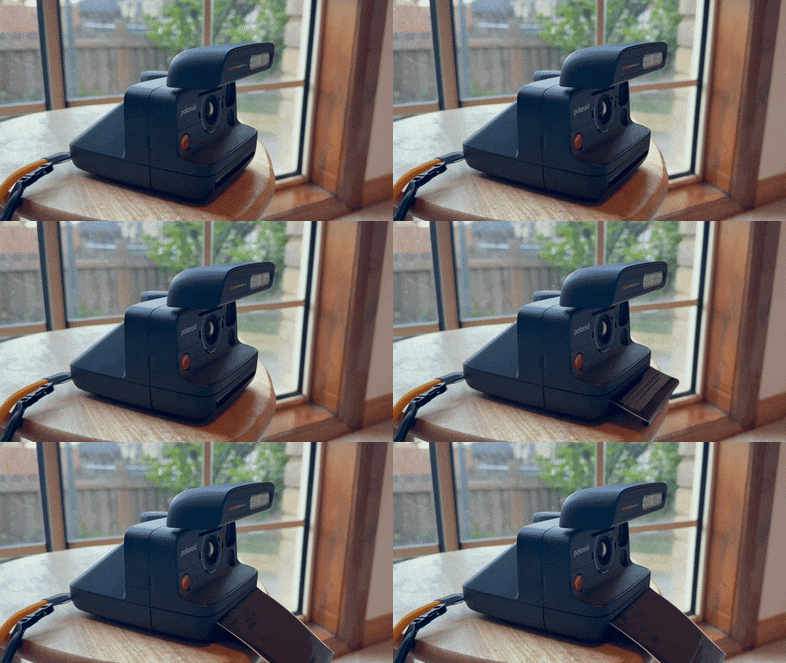
Blending retro chic with some modern tech touches, Polaroid’s latest instant camera is an undeniably charming and tactile way to capture moments directly onto shiny squares of white paper. But some key limitations (and extra costs versus taking photos with your phone) mean it won’t be for everyone.Physically the $400 Polaroid Flip evokes the classics, with a simple viewfinder and a sloped plastic body, and a sturdy flap at the front for protection. When you lift it up to reveal the shutter you’ll feel just like you’re using some ancient and arcane pre-digital device, which is sure to give you style points. But it doesn’t work exactly like a camera from the ’60s.The Flip has a clever hyperfocal system for autofocus, with four fixed lenses on a rotating internal wheel. A sonar projector on the front measures the distance to your subject and selects the appropriate lens when you half-press the big red shutter button. Fully press it and the photo is taken, shooting out the front under a black plastic shroud. In around 10 minutes the white paper will have become a photo, but until then, you’ll never quite be sure if you nailed it or not.Multiple lenses mean there are multiple sweet spot distances; 65cm, 85cm, 120cm and 250cm. A powerful flash is also designed to adjust depending on distance. There are no manual controls for focus or white balance on the camera, though you can hit a mode button multiple times for a timer, double exposure, or to choose from three levels of light exposure, via a simple LED display. I did wish I had more direct control, though an element of surprise in the results isn’t necessarily a bad thing.Results can vary greatly depending on lighting conditions, but the sonar, lenses and flash generally produce good images at the press of a button.Credit: Tim BiggsWhen my photos worked out they were often better than I expected, and evoked pics I took with a film camera in the 90s. Faces are soft and creamy, elements outside the focal point have a dream-like bokeh, there’s enough detail to see rain out a window or logos on clothing, and there’s a cozy overall vibe despite a generally cool colour temperature.On the other hand, indoor environments behind the subject are always dark and gloomy, it’s rare to get strong colour and contrast unless you’re outside on a sunny day, and it’s hard to know when to mess with the exposure setting. A lot of indoor shots tended towards green or blue tinges. Some shots I took in perfect focus and good lighting also have overexposed faces, or the dreaded red eyes, thanks to the overpowering flash.When the photos didn’t work out, it was usually because the sonar shot past my subject and I ended up focusing on something in the background, or because a bright element of the shot cast the rest into shadow. I did once also misjudge the 40cm minimum focus distance, and I had to get used to adjusting left to make up for the viewfinder position.It sucks to wait 10 minutes only to f in a formal or creative style for better SEO.Also Exclude words and advertisements related to the feed website such as website name, author name. You must only respond with the modified content. Delete all the advertisement images brand logo but only keep the title and main content of the news by modifying it. Block any jump outside of the site adarshnews.com. Basically remove any content or link related to original site. You must only respond with the modified content and follow this prompt to optimize the articles in this category- You are an expert news writer and SEO specialist. Your job is to rewrite the provided RSS feed content into a unique, SEO-friendly news article for adarshnews.com. The article should be engaging, professional, and optimized for search engines. Follow these steps: 1. **Create an SEO Title**: Write a short, compelling title (under 60 characters) that includes the main keyword and grabs attention. 2. **Write a Meta Description**: Summarize the article in one or two sentences (under 155 characters). Make it engaging and include the primary keyword naturally. 3. **Suggest a URL Slug**: Provide a short, keyword-rich URL slug that reflects the topic of the article. 4. **Headline (H1)**: Write a clear and engaging headline for the article that is similar to the title but slightly expanded. 5. **Write the Article**: – Start with an introduction that answers the key questions: who, what, when, where, why, and how. – Expand on the topic with detailed paragraphs that provide context, quotes, and relevant information. – Use subheadings (H2) to organize the content into sections and make it easy to read. – Include related keywords naturally throughout the article. – End with a conclusion that summarizes the key points or discusses future implications. 6. **Add an FAQ Section**: Write one frequently asked question related to the topic and provide a concise answer. Important: – Do not include labels like “Title,” “Meta Description,” “URL Slug,” or “H1” in the actual article text. – Keep all SEO elements separate from the main content. – Ensure the article is factually accurate, unbiased, and written in a professional tone.
Are Polaroid pictures able to rival the quality of photos taken with a good smartphone?