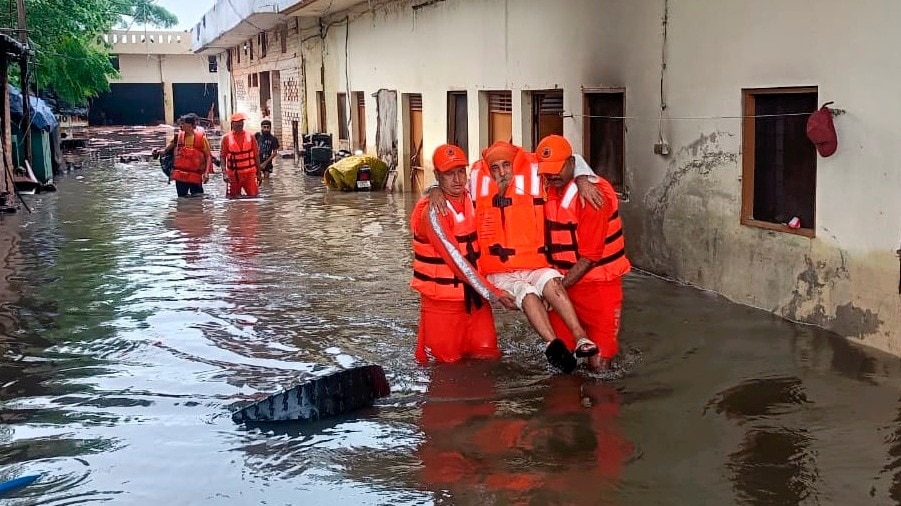
The devastating floods in Punjab have once again brought into sharp focus the question of accountability, with experts calling the tragedy a result of negligence and corruption rather than nature’s fury.Lt Gen (Retd) KJS Dhillon, who has closely studied the terrain of Punjab and the Ravi river basin, termed the situation “criminal negligence.” He explained that the Ravi enters Punjab at Madhavpur and flowing through the Ajnala sector before meandering along the international border, is a flood-prone region where timely measures were critical.advertisement“Two things are crucial — accurate forecasts from the weather department and proper management of dam waters. You cannot release water suddenly, it triggers flooding. Earlier, people would be alerted by drum beats. Now, routine text messages go unnoticed. District Collectors must ensure timely warnings to the Patwaris,” he said, stressing that the response came too late.Dhillon also pointed to corruption in maintaining anti-flood bunds along the Ravi, which double as defence bunkers. “Every year, funds are allocated for maintenance. If used properly, these embankments could have been as strong as the Great Wall of China. But the canals are not desilted, and the dhusi (embankments) are broken. This negligence worsened the disaster.”Calling the floods a “man-made tragedy,” Dhillon said that despite the presence of the army and local administration, 90 per cent of relief work is being carried out by volunteers and ordinary citizens. The administration has failed to plan for livestock shelters, relief camps, or evacuation. Instead, politicians are using the crisis for photo opportunities.”Agriculture expert Devinder Sharma echoed similar concerns, blaming “successive governments” for unplanned development at the cost of the environment. “Four-lane highways, housing projects, indiscriminate tree-cutting, and failure to desilt dams and canals have cumulatively led to this disaster. If hard decisions are not made, Punjab will continue to face such tragedies. Development must never come at the cost of the environment,” Sharma said.Both experts agreed that unless governance shifts from reactive relief to proactive prevention, Punjab’s flood-prone districts will remain vulnerable.- EndsTune In in a formal or creative style for better SEO.Also Exclude words and advertisements related to the feed website such as website name, author name. Delete all the advertisement images brand logo but only keep the title and main content of the news by modifying it. You must only respond with the modified content. Block any jump outside of the site adarshnews.com. Basically remove any content or link related to original site. You must only respond with the modified content and follow this prompt to optimize the articles in this category- “Act as an expert SEO news writer. Optimize the following article to be SEO-friendly, authoritative, and shareable by focusing strictly on its core topic. Follow these steps: You are an expert news writer and SEO specialist. Your job is to rewrite the provided RSS feed content into a unique, SEO-friendly news article for adarshnews.com. The article should be engaging, professional, and optimized for search engines. Follow these steps: 1. **Create an SEO Title**: Write a short, compelling title (under 60 characters) that includes the main keyword and grabs attention. 2. **Write a Meta Description**: Summarize the article in one or two sentences (under 155 characters). Make it engaging and include the primary keyword naturally. 3. **Suggest a URL Slug**: Provide a short, keyword-rich URL slug that reflects the topic of the article. 4. **Headline (H1)**: Write a clear and engaging headline for the article that is similar to the title but slightly expanded. 5. **Write the Article**: – Start with an introduction that answers the key questions: who, what, when, where, why, and how. – Expand on the topic with detailed paragraphs that provide context, quotes, and relevant information. – Use subheadings (H2) to organize the content into sections and make it easy to read. – Include related keywords naturally throughout the article. – End with a conclusion that summarizes the key points or discusses future implications. 6. **Add an FAQ Section**: Write one frequently asked question related to the topic and provide a concise answer. Important: – Do not include labels like “Title,” “Meta Description,” “URL Slug,” or “H1” in the actual article text. – Keep all SEO elements separate from the main content. – Ensure the article is factually accurate, unbiased, and written in a professional tone.
Could the floods in Punjab be attributed to human negligence? According to specialists…