


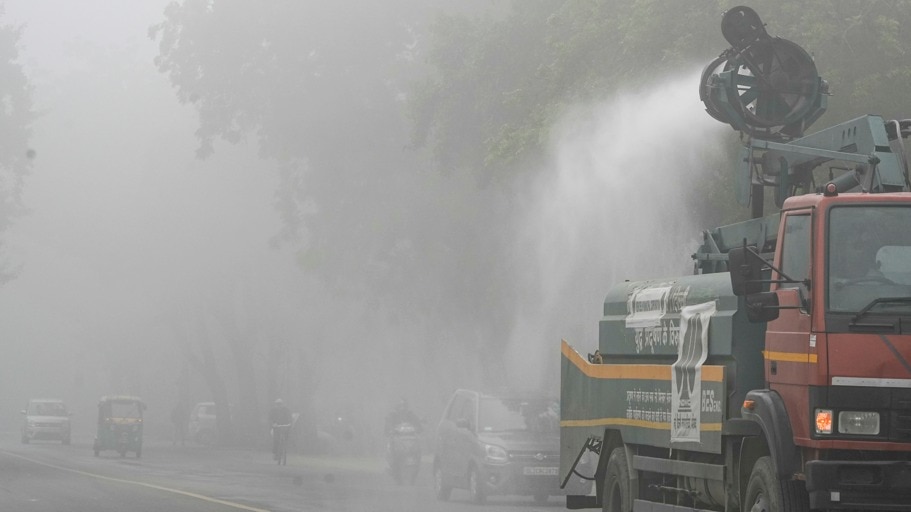
**Delhi’s Air Quality Reaches Hazardous Levels, Flights Disrupted**
Delhi is grappling with another day of hazardous air quality as the Air Quality Index (AQI) soared to 498 on Monday morning, later settling at 427 by evening, categorizing the pollution level as “severe.” The thick layer of toxic haze has resulted in significant disruptions at the airport, with at least 228 flights canceled, including 131 departures and 97 arrivals, and five flights diverted.
IndiGo Airlines reported that persistent low visibility in the morning led to air traffic disruptions, prompting the cancellation of several flights to ensure safe operations throughout the day. Passengers at Delhi airport faced chaotic conditions, with many stranded and waiting for hours to retrieve their luggage. Sam Dalrymple, son of the noted historian William Dalrymple, expressed frustration after being stuck at the airport for 12 hours. He criticized Air India for its lack of communication, stating, “There was no staff to tell the passengers that it was cancelled.”
With dense fog anticipated for Tuesday morning, Air India announced the cancellation of “select scheduled flights.” To alleviate passenger inconvenience, the airline has activated its Fog Care program, which notifies affected passengers in advance and offers complimentary rescheduling or full refunds without penalties.
In response to the deteriorating air quality, the Delhi government has mandated that students from nursery to Class 5 will now attend classes exclusively online, discontinuing the previous option for parents to choose between physical and virtual classes. The Directorate of Education issued a circular stating that physical classes for these students will remain suspended until further notice, applicable to all recognized schools in the capital. School administrators have been instructed to ensure that online classes are conducted for these students, while classes for higher grades will continue as previously directed.
According to the Central Pollution Control Board (CPCB), 27 monitoring stations across Delhi reported “severe” air quality, with 12 stations indicating “very poor” levels. Wazirpur recorded the highest AQI at 475, while the CPCB did not register any values above 500. Data from the Air Quality Early Warning System revealed PM2.5 concentrations at 154.96 micrograms per cubic meter and PM10 at 260.9 micrograms per cubic meter, significantly exceeding the national standard of 40 micrograms per cubic meter for PM2.5. Transport activities contributed 3.079% to the total pollution, while construction activities accounted for 1.732%.
As Delhi continues to battle severe air pollution, the implications for public health and daily life remain a pressing concern.
**FAQ**
**What measures is the Delhi government taking in response to air pollution?**
The Delhi government has mandated that students from nursery to Class 5 attend classes online only, discontinuing physical classes until further notice due to high AQI levels.


