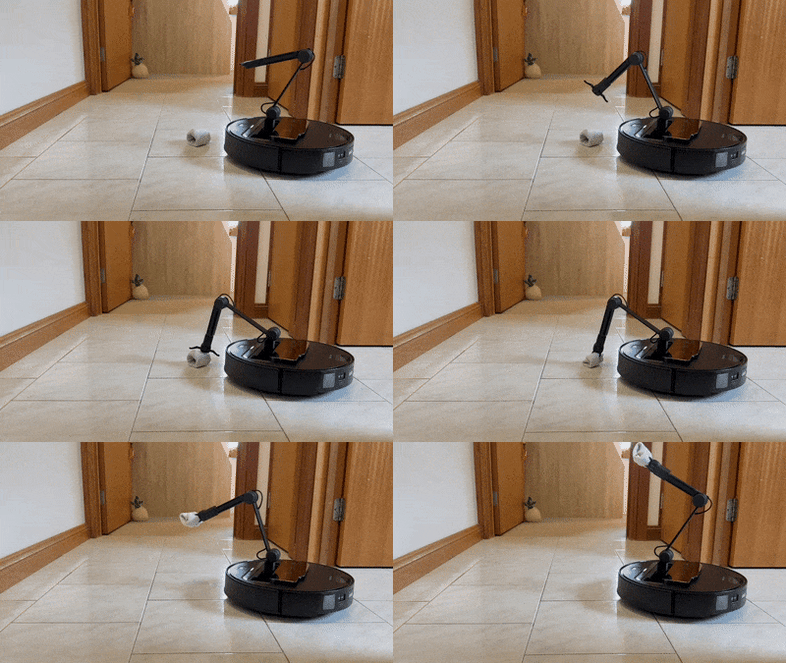
Robot vacuums are developing new features very quickly. A year ago, self-scrubbing docks that emptied dirty water into an on-board tank to keep mop pads clean and dry were a fresh innovation. Then, the robots developed wheels and legs that let them hop over tricky room transitions.Now Roborock is first to market with the next big trick; a robot with a full mechanical arm folded into its body, designed to physically pick up and relocate objects in its way.Roborock’s fine print says the Z70 can spot and sort socks, sandals, tissues, and towels. But it turns out there are a few more limitations.The idea seems like pure science fiction. Imagine that, while you’re out of the house, a robot emerges to vacuum and mop. It gets in all the nooks and crannies and, if you’ve left any small objects on the floor, it picks them up. You’ll find them neatly placed where they’re supposed to go — or stowed in the robot’s own little lost-and-found basket — when you get home.It’s an intriguing glimpse of the future, but Roborock’s $4000 Saros Z70 can’t make it a reality quite yet. The company says the robot can only pick up a very few objects, including socks, cloths, tissues and sandals. And, as I found out, it will only do that in very specific scenarios.The bot comes with a sleek and futuristic-looking dock, plus a gaudy cardboard bin covered with QR codes into which it can deposit objects. After setting it up and letting it map my house (which it did quickly thanks to its cameras and sensors), I immediately enacted a simple test I thought would be a slam dunk for the robot arm. I decluttered the kids’ bedroom and placed a single sock in the middle of the floor, then asked the robot to come and vacuum.It began cleaning in a grid and clearly saw the sock, as it deviated from its pattern to carefully clean around it. Then it finished the job and returned to its dock. Strike one, the sock was still on the floor.Upon checking the app, it seems the robot detected the sock as a generic obstacle. My fault, the sock wasn’t socky enough. I chose an unmistakable specimen for the second test; white and well-worn, with a green toe. The very visual definition of a sock. The robot avoided it completely. Strike two.I decided to change tack and replace the sock with a kitchen cloth. The robot ran over it, dragging it around the room. Strike three.At this point the floor was very clean and I just wanted to see the grabber, so I activated the manual mode that let me take direct control. The arm looks as you’d expect; a five-axis black robotic pincher on a pole, with neat cabling. It’s impressive that it fits in the robot, but I hate to think what could happen if debris gets stuck in its hidey hole before it returns home.I pointed out where the sock was and asked the robot to collect it. It said there were no liftable items in view. I switched the arm to manual and controlled it to grab the sock in a surprisingly tight grip, then drove the robot to its in a formal or creative style for better SEO.Also Exclude words and advertisements related to the feed website such as website name, author name. You must only respond with the modified content. Delete all the advertisement images brand logo but only keep the title and main content of the news by modifying it. Block any jump outside of the site adarshnews.com. Basically remove any content or link related to original site. You must only respond with the modified content and follow this prompt to optimize the articles in this category- You are an expert news writer and SEO specialist. Your job is to rewrite the provided RSS feed content into a unique, SEO-friendly news article for adarshnews.com. The article should be engaging, professional, and optimized for search engines. Follow these steps: 1. **Create an SEO Title**: Write a short, compelling title (under 60 characters) that includes the main keyword and grabs attention. 2. **Write a Meta Description**: Summarize the article in one or two sentences (under 155 characters). Make it engaging and include the primary keyword naturally. 3. **Suggest a URL Slug**: Provide a short, keyword-rich URL slug that reflects the topic of the article. 4. **Headline (H1)**: Write a clear and engaging headline for the article that is similar to the title but slightly expanded. 5. **Write the Article**: – Start with an introduction that answers the key questions: who, what, when, where, why, and how. – Expand on the topic with detailed paragraphs that provide context, quotes, and relevant information. – Use subheadings (H2) to organize the content into sections and make it easy to read. – Include related keywords naturally throughout the article. – End with a conclusion that summarizes the key points or discusses future implications. 6. **Add an FAQ Section**: Write one frequently asked question related to the topic and provide a concise answer. Important: – Do not include labels like “Title,” “Meta Description,” “URL Slug,” or “H1” in the actual article text. – Keep all SEO elements separate from the main content. – Ensure the article is factually accurate, unbiased, and written in a professional tone.
I tested a robot vacuum that comes equipped with a mechanical arm.