**Humanoid Robots: UBTech’s Bold Step into the Future of Work**
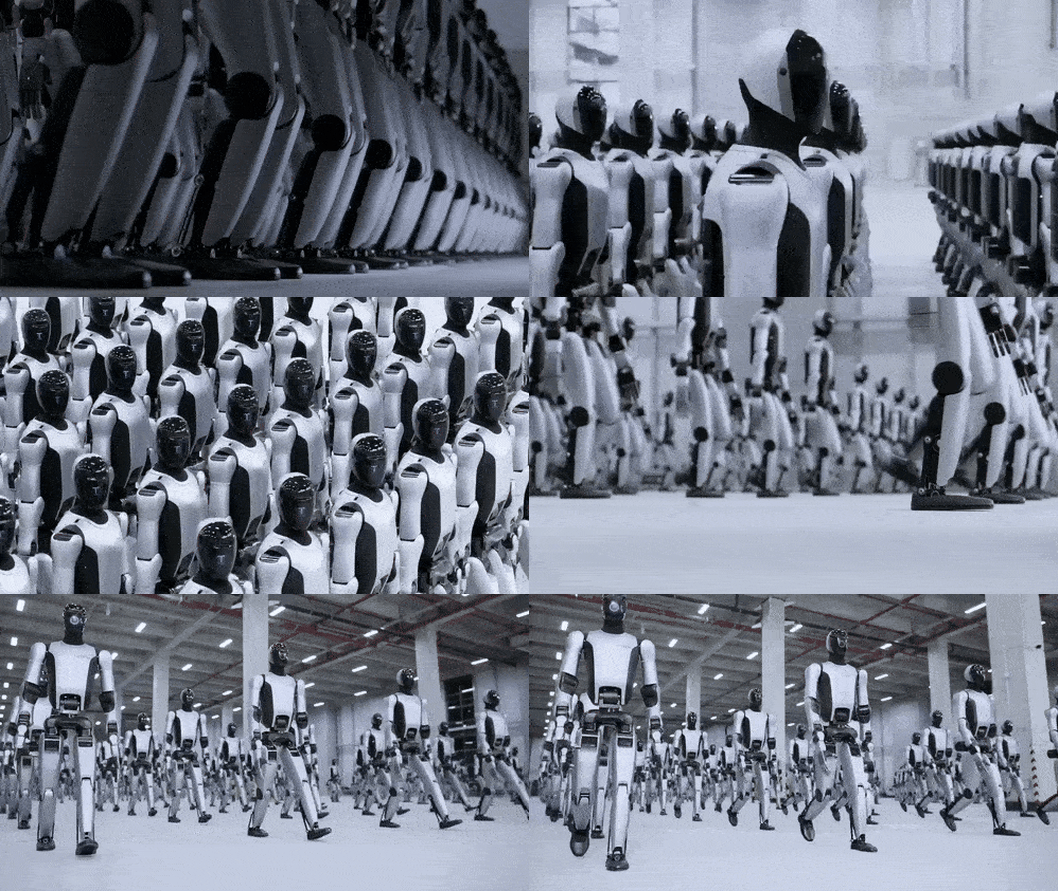
In a recent video released by UBTech, a Chinese robotics company, hundreds of humanoid robots are seen marching in unison, neatly lining up and rhythmically packing themselves into delivery trucks. This marks UBTech’s claim of achieving its first mass shipments of these robots to customers, a milestone that competitors like Tesla and Figure have yet to reach. The video has sparked a mix of awe and concern among viewers, with comments ranging from fears of job displacement to visions of a robotic military force. However, many questions linger for the more skeptical observer.
Is the synchronized marching a genuine feature of the robots, or merely a spectacle? Do they appear as unsteady as they seem? Why not showcase footage of them performing actual work tasks? Additionally, how autonomous are these robots in unfamiliar environments? Are any of the visuals altered or enhanced through CGI? And most importantly, who is purchasing these robots and for what specific applications?
UBTech offers various models, including the Walker S2 units, which are marketed as industrial factory personnel capable of operating autonomously and indefinitely due to their self-recharging battery system. These robots boast dexterous hands, a rotating waist, and a human-like gait, with promotional materials depicting them lifting heavy boxes and sorting components. The company has reported multiple orders from Chinese enterprises, including a data-collection center and a government-backed car manufacturer, with plans to deliver 500 robots by the end of 2025. UBTech’s stock has surged over 150% this year.
Despite the excitement surrounding humanoid robots as the future of the workforce, skepticism remains about the practicality of such designs for factory settings. The complexity of getting a bipedal robot to perform simple tasks, which humans find effortless, is immense. Most companies in the humanoid robotics sector, including Tesla, are still far from deploying robots that can work autonomously. Current public demonstrations are often limited to controlled environments, with robots either tethered or remotely operated by humans.
In conclusion, while UBTech’s advancements in humanoid robotics are noteworthy, the reality of their operational capabilities raises significant questions. The notion that humanoid robots are ready to take on work tasks may be more aspirational than factual at this stage.
**FAQ**
**Q: What are the main features of UBTech’s Walker S2 robots?**
A: The Walker S2 robots are designed for industrial use, featuring autonomous operation, self-recharging batteries, dexterous hands, and a human-like gait, enabling them to perform various tasks in factory settings.