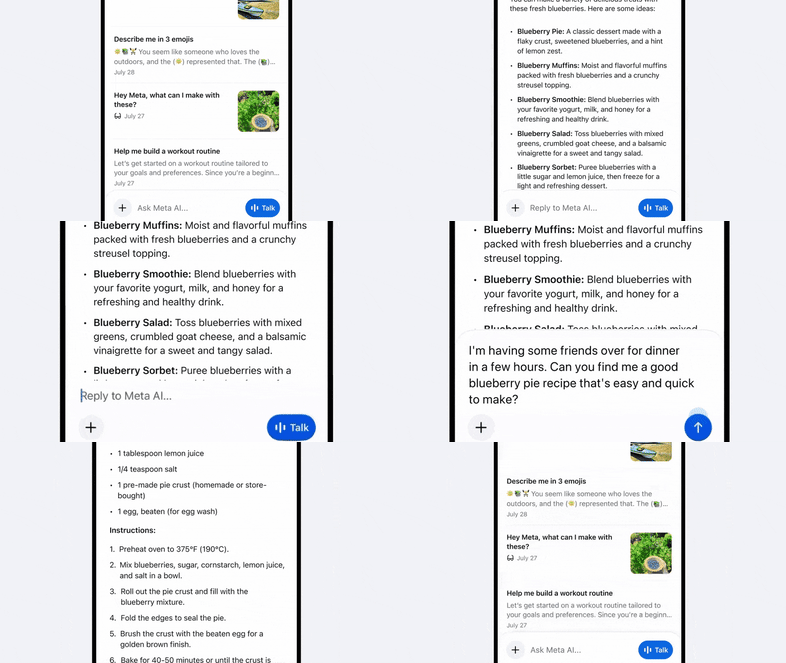
Mark Zuckerberg has a new way to invade your privacy: a creepier version of ChatGPT.Last week, Facebook’s co-founder launched the Meta AI app, a dedicated home for his company’s artificial intelligence chatbot. The app, which climbed to No. 2 on the iPhone free download charts, promises users a more “personalised” AI with tailored answers and advice. And it includes a new social network for people to share their AI conversations and images.Mark Zuckerberg has a new way of invading your privacy. Credit: BloombergBut Meta AI also brings something else to chatbots: surveillance. The first time I opened the app, I asked it to “describe me in three emojis.” It could, by drawing on years of personal information tracked by its sister apps Facebook and Instagram.As a test, I also chatted with Meta AI about some intentionally sensitive topics. Afterward, I found it built a so-called Memory file about me that said my interests include natural fertility techniques, divorce, child custody, a payday loan and the laws about tax evasion.In fact, Meta AI by default kept a copy of everything I said to it – to tailor its responses to me, to train a future version of Meta’s AI and, eventually, target me with ads. I was later able to delete its memory and my conversations, with some effort. But from my tests, Meta AI pushes the limits on privacy in ways that go much further than rivals ChatGPT, from OpenAI, or Gemini, from Google.Whatever you chat about with Meta AI, just picture Zuckerberg watching. My conversations were tests, but more and more people are turning to AI for incredibly personal stuff, from medical problems to virtual boyfriends.Meta says its AI gives people what they want. “We’ve provided valuable personalisation for people on our platforms for decades, making it easier for people to accomplish what they come to our apps to do – the Meta AI app is no different,” said Meta spokesman Thomas Richards. “We provide transparency and control throughout, so people can manage their experience and make sure it’s right for them.”But for most users, Meta AI’s personalisation brings a whole new set of privacy risks they might not yet appreciate, much less know how to control.“The disclosures and consumer choices around privacy settings are laughably bad,” says Ben Winters, the director of AI and data privacy at the Consumer Federation of America. “I would only use it for surface-level, fun prompts or things that don’t have anything to do with your personal information, desire, concerns, fears, or anything you wouldn’t broadcast to the internet.”Personalised AI’s privacy problemsA virtual assistant that can anticipate your needs – or even be your therapist – is the holy grail of AI. And Meta is not the only company pushing deeper into personal data in the hunt for it.Google recently added an option to Gemini that lets you choose to use your Google search history to personalise its responses. ChatGPT has added the ability in a formal or creative style for better SEO.Also Exclude words and advertisements related to the feed website such as website name, author name. You must only respond with the modified content. Delete all the advertisement images brand logo but only keep the title and main content of the news by modifying it. Block any jump outside of the site adarshnews.com. Basically remove any content or link related to original site. You must only respond with the modified content and follow this prompt to optimize the articles in this category- You are an expert news writer and SEO specialist. Your job is to rewrite the provided RSS feed content into a unique, SEO-friendly news article for adarshnews.com. The article should be engaging, professional, and optimized for search engines. Follow these steps: 1. **Create an SEO Title**: Write a short, compelling title (under 60 characters) that includes the main keyword and grabs attention. 2. **Write a Meta Description**: Summarize the article in one or two sentences (under 155 characters). Make it engaging and include the primary keyword naturally. 3. **Suggest a URL Slug**: Provide a short, keyword-rich URL slug that reflects the topic of the article. 4. **Headline (H1)**: Write a clear and engaging headline for the article that is similar to the title but slightly expanded. 5. **Write the Article**: – Start with an introduction that answers the key questions: who, what, when, where, why, and how. – Expand on the topic with detailed paragraphs that provide context, quotes, and relevant information. – Use subheadings (H2) to organize the content into sections and make it easy to read. – Include related keywords naturally throughout the article. – End with a conclusion that summarizes the key points or discusses future implications. 6. **Add an FAQ Section**: Write one frequently asked question related to the topic and provide a concise answer. Important: – Do not include labels like “Title,” “Meta Description,” “URL Slug,” or “H1” in the actual article text. – Keep all SEO elements separate from the main content. – Ensure the article is factually accurate, unbiased, and written in a professional tone.
Mark Zuckerberg has introduced a concerning new method to intrude on your privacy.