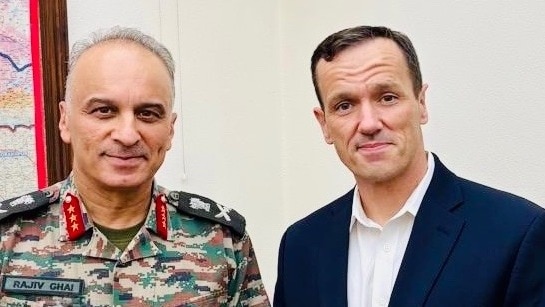
John Spencer, Executive Director of the Urban Warfare Institute and a globally recognised authority on modern military operations, has shared his reflections on a recent visit to India, offering rare insights into the country’s evolving defence posture and the growing sophistication of its military response mechanisms.In a detailed post published on X, with a photograph of his meeting with India’s Director General of Military Operations, Lieutenant General Rajiv Ghai, Spencer described his visit as “extremely informative,” underscoring a dramatic shift in India’s national security paradigm.advertisement“The old assumptions about India’s strategic posture no longer apply,” Spencer wrote. “The country is transforming in doctrine, technology, and geopolitical outlook.”A central theme of his post was Operation Sindoor, India’s military response to the April 22 Pahalgam massacre, which Spencer called a “strategic turning point.” According to him, Indian military leaders did not view the operation as a one-off counterterrorism action but as part of a new, proactive doctrine—focused on precision, speed, and deterrence.Spencer emphasised the depth of preparation behind the operation, citing months of wargaming, intelligence fusion, and pre-positioned defense assets. Of particular note was India’s reliance on long-range fires, including rocket artillery and loitering munitions, rather than traditional airstrikes. Seven out of nine identified terrorist targets were reportedly neutralised using these methods.Counter-drone warfare featured prominently, with a layered defense system that combined radars, jammers, and both kinetic and soft-kill systems, including the effective use of legacy L-70 guns integrated with modern platforms. Persistent intelligence, surveillance, and reconnaissance (ISR) from satellites and human intelligence sources enabled real-time battle damage assessments.“What stood out was the clarity and firmness of India’s red lines,” Spencer noted. “Every terrorist attack will receive a military response. There will be no distinction between the attacker and those who support or harbor them.”Beyond the battlefield, Spencer detailed India’s broader defense and technological transformation. He highlighted the growing role of private defense startups, including firms working on autonomous systems, GPS-independent drones, and indigenous air defense technologies — driven by India’s ‘Make in India’ initiative.On Kashmir, Spencer observed a notable shift in ground realities. While acknowledging the continued threat of cross-border infiltration, disinformation, and narrative manipulation, he reported growing tourism, infrastructure development, and democratic engagement. Local communities, he said, are increasingly rejecting extremist violence.Spencer’s conversations spanned a wide range of strategic domains, including airpower, deterrence, cyber, space, semiconductors , and supply chain security. in a formal or creative style for better SEO.Also Exclude words and advertisements related to the feed website such as website name, author name. Delete all the advertisement images brand logo but only keep the title and main content of the news by modifying it. You must only respond with the modified content. Block any jump outside of the site adarshnews.com. Basically remove any content or link related to original site. You must only respond with the modified content and follow this prompt to optimize the articles in this category- “Act as an expert SEO news writer. Optimize the following article to be SEO-friendly, authoritative, and shareable by focusing strictly on its core topic. Follow these steps: You are an expert news writer and SEO specialist. Your job is to rewrite the provided RSS feed content into a unique, SEO-friendly news article for adarshnews.com. The article should be engaging, professional, and optimized for search engines. Follow these steps: 1. **Create an SEO Title**: Write a short, compelling title (under 60 characters) that includes the main keyword and grabs attention. 2. **Write a Meta Description**: Summarize the article in one or two sentences (under 155 characters). Make it engaging and include the primary keyword naturally. 3. **Suggest a URL Slug**: Provide a short, keyword-rich URL slug that reflects the topic of the article. 4. **Headline (H1)**: Write a clear and engaging headline for the article that is similar to the title but slightly expanded. 5. **Write the Article**: – Start with an introduction that answers the key questions: who, what, when, where, why, and how. – Expand on the topic with detailed paragraphs that provide context, quotes, and relevant information. – Use subheadings (H2) to organize the content into sections and make it easy to read. – Include related keywords naturally throughout the article. – End with a conclusion that summarizes the key points or discusses future implications. 6. **Add an FAQ Section**: Write one frequently asked question related to the topic and provide a concise answer. Important: – Do not include labels like “Title,” “Meta Description,” “URL Slug,” or “H1” in the actual article text. – Keep all SEO elements separate from the main content. – Ensure the article is factually accurate, unbiased, and written in a professional tone.
Op Sindoor signifies a new phase in India’s military strategy, according to a US warfare specialist.