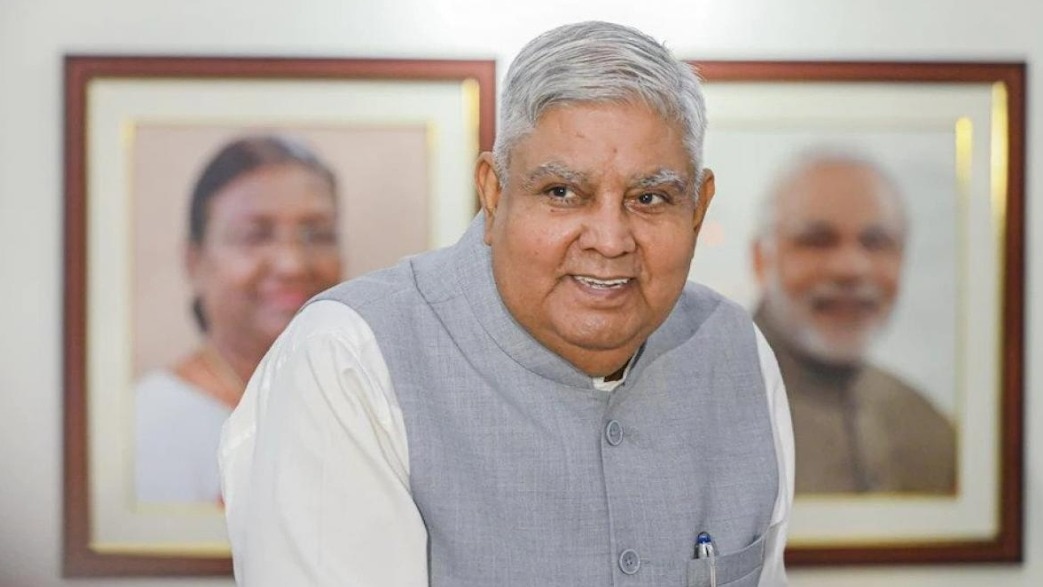
**NDA Poised for Vice Presidential Election Following Dhankhar’s Resignation**
The ruling National Democratic Alliance (NDA) is in a strong position for the upcoming vice presidential election, prompted by the unexpected resignation of Jagdeep Dhankhar on Monday. The vice president is elected by members of both the Lok Sabha and Rajya Sabha, with nominated members of the Upper House also eligible to vote.
Currently, the Lok Sabha, which has 543 members, has one vacant seat in Basirhat, West Bengal. Meanwhile, the Rajya Sabha, consisting of 245 members, has five vacancies—four from Jammu and Kashmir and one from Punjab. The Punjab seat became vacant after Sanjeev Arora resigned following his election to the state assembly in a recent bypoll.
The combined effective strength of both Houses is 786, meaning a candidate needs 394 votes to secure victory in the vice presidential election, assuming all eligible voters participate. The BJP-led NDA commands the support of 293 members in the Lok Sabha and 129 members in the Rajya Sabha, which has an effective strength of 240, provided that the nominated members back the NDA candidate. Overall, the ruling alliance has the backing of 422 members across both Houses.
According to Article 68 of the Constitution, an election to fill a vice presidential vacancy must be conducted “as soon as possible” after it arises due to death, resignation, or removal. The elected individual will serve a full five-year term starting from the date they assume office. Article 66(1) stipulates that the election will follow the Proportional Representation system through a single transferable vote, with voting conducted via secret ballot, allowing electors to rank candidates by preference.
The vice president holds the second-highest constitutional office in India, serving a five-year term but remaining in office until a successor is appointed. Dhankhar’s resignation, effective immediately, was submitted to President Droupadi Murmu, citing medical reasons.
In summary, the NDA’s strong support in both Houses positions it favorably for the upcoming election, with the process set to unfold in accordance with constitutional guidelines.
**FAQ**
**What happens after a vice presidential vacancy occurs?**
An election must be held as soon as possible to fill the vacancy, and the elected individual will serve a full five-year term from their start date.