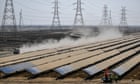
The Indian government has eased national security protocols along the Pakistan border to facilitate the establishment of a renewable energy park, a project awarded to one of India’s wealthiest individuals, Gautam Adani, as revealed by official documents. The Adani Group is developing the Khavda plant, which is set to be the largest renewable energy project globally, located in Gujarat. Adani, who leads the conglomerate, has faced increased scrutiny due to his close ties with Prime Minister Narendra Modi.
In November, the U.S. government accused the billionaire of fraud related to a multimillion-dollar bribery scheme involving renewable energy from the Khavda complex, allegations he has denied. The Adani Group has become a dominant force in India’s expanding green energy sector, with Khavda central to its renewable energy ambitions. The plant’s significance to India’s energy independence and renewable commitments led to its inauguration by Modi in 2020.
However, national security concerns have emerged regarding the project. Private communications and confidential government minutes reviewed indicate that the defense ministry modified security protocols to make sensitive areas along the India-Pakistan border commercially viable for developers. The Adani Group is constructing solar panels and wind turbines just 1 kilometer from the Pakistan border in the Rann of Kutch, on land leased from the Gujarat government. This region has been a focal point in past India-Pakistan conflicts and is near Sir Creek, a disputed area.
Previously, national defense protocols prohibited significant construction beyond existing villages and roads within 10 kilometers of the Pakistan border, hindering large-scale solar installations. However, documents reveal that the Gujarat government, under Modi’s Bharatiya Janata Party (BJP), advocated for the relaxation of these protocols to enable solar and wind development in the Rann of Kutch.
Official communications show that prior to April 2023, Gujarat officials sent a letter to the Prime Minister’s Office requesting that the issue be addressed with the defense ministry. A confidential meeting was subsequently held in Delhi on April 21, 2023, to discuss the solar proposal, attended by military operations officials and representatives from Gujarat and the ministry of renewable energy.
During this meeting, senior military officials expressed concerns about the potential impact of solar panels on tank mobility and security surveillance along the international border. However, developers assured that the solar platforms would effectively mitigate any threats posed by enemy tank movements.