Robot vacuums are rapidly evolving with new capabilities. While each advancement may not warrant an upgrade to a new, costly model, these enhancements accumulate, making current high-end devices significantly more effective and versatile compared to those from three years ago. The upcoming Dreame X50 Ultra, priced at $3000 and set to launch in Australia next month, stands out as the most impressive model to date. Building on the already exceptional X40, which features self-cleaning and detachable mop pads, the X50 Ultra introduces increased suction power, hotter water, descaling, hot-air mop drying, self-adjusting detergent mixing, UV sterilization, and improved obstacle detection.
In addition to these fundamental upgrades, the X50 Ultra incorporates new hardware designed to tackle specific challenges within the home. For instance, in kitchens and bathrooms where dirt accumulates in corners and along edges, the mop pads are now mounted on mechanical arms that can extend to clean hard-to-reach areas. To access spaces beneath couches and furniture, the robot can retract its sensor tower, allowing it to fit into tighter spots.
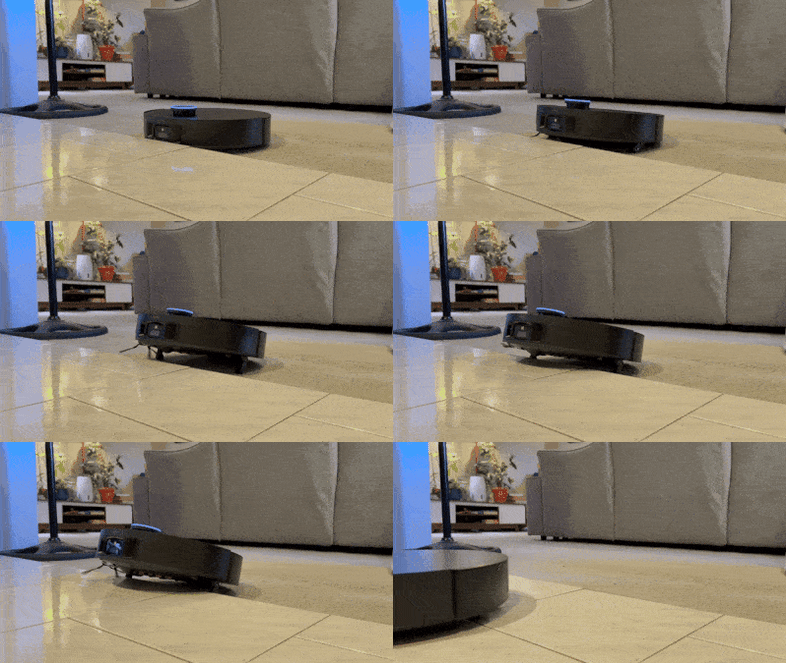
For homes with raised floors, transitions between rooms, sliding door tracks, or thick carpets that typically pose challenges, the X50 Ultra features a “Pro Leap” system. This system consists of rotating legs with wheels that assist the device in overcoming these obstacles.
This is the second robot I’ve tested with climbing capabilities, and while both the X50 Ultra and Roborock’s Qrevo Edge address the issue differently, they both demonstrate impressive functionality. Roborock’s model uses a front wheel to lift its frame and push over obstacles, while the X50 Ultra raises itself on its legs, positioning its front over the step before rotating its legs to land on the higher surface.
For added safety on sliding door tracks and similar areas, the X50 Ultra can be set to step with one leg at a time, preventing it from tipping over. The system performed smoothly and reliably when navigating a four-centimeter transition between tiled and carpeted areas in my home, with only one minor hiccup.
While the Edge model automatically recognized and navigated transitions, the X50 Ultra did not attempt to climb during its initial mapping run, instead bumping against the tiles until I intervened. After returning it to its charging dock, I accessed the app, which allowed me to manually mark passable thresholds on the map. Once I did this, the robot successfully navigated those areas.
This feature likely serves as a safety precaution; since the robot bypasses some of its usual fall prevention sensors when climbing, it could potentially attempt to ascend near stairs and risk a fall. However, this caution also limits the Pro Leap system’s effectiveness. If the robot encounters an obstacle that hasn’t been specifically marked on the map, it will not attempt to overcome it. I tested this by placing a three-centimeter rug in an unexpected location, and the robot ceased its efforts when it couldn’t navigate the new challenge.