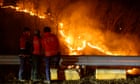
Authorities in South Korea are battling wildfires that have doubled in size in a day in the country’s worst ever natural fire disaster.At least 27 people have died and hundreds of buildings destroyed in the south-eastern province of North Gyeongsang, with the country’s disaster chief saying the fires had exposed the “harsh reality” of global heating.Pointing to ultra-dry conditions and strong winds that have worsened the damage, Lee Han-kyung, disaster and safety division chief, said: “This wildfire has once again exposed the harsh reality of a climate crisis unlike anything we’ve experienced before.”The affected areas have seen only half the average rainfall this season, while the country has experienced more than double the number of fires this year than last.More than 36,000 hectares (88,960 acres) have been charred or were still burning in the largest of the fires, which began in the central Uiseong county, making it the biggest single forest fire in South Korea’s history. About 37,000 people have been displaced, the Yonhap news agency said.“We are nationally in a critical situation with numerous casualties because of the unprecedented rapid spread of forest fires,” the acting president, Han Duck-soo, told a government response meeting, adding that the high number of older victims, including those in nursing hospitals, was a particular concern.The military has released stocks of aviation fuel to help keep firefighting helicopters flying to douse flames across mountainous regions in the province, where fires have been burning now for nearly a week. More than 300 structures had been destroyed, officials said.As of Thursday morning, authorities were mobilising more than 9,000 people and about 120 helicopters to battle the fires, the government’s disaster response centre said.The country’s disaster chief said the wildfires were now “the largest on record”, having burned more forest than any previous blazes. The last major wildfire, in April 2020, scorched 23,913 hectares across the east coast.“The wildfire is spreading rapidly,” Lee said. “The forest damage has reached 35,810 hectares, already exceeding the area affected by the 2000 east coast wildfire, previously the largest on record, by more than 10,000 hectares.”The fatalities include a pilot whose helicopter crashed during efforts to contain a fire and four firefighters and other workers who died after being trapped by fast-moving flames driven by strong winds.Authorities have not disclosed details of the civilian dead, except that they are mainly in their 60s and 70s. They suspect human error caused several of the wildfires that began last Friday, including cases where people started fires while clearing overgrown grass from family tombs or with sparks during welding work.Last year was South Korea’s hottest year on record, with the Korea Meteorological Administration saying that the average annual temperature was 14.5C – two degrees higher than the pr in a formal or creative style for better SEO.Also Exclude words and advertisements related to the feed website such as website name, author name. You must only respond with the modified content. Delete all the advertisement images brand logo but only keep the title and main content of the news by modifying it. You must only respond with the modified content. Block any jump outside of the site adarshnews.com. Basically remove any content or link related to original site. You must only respond with the modified content and follow this prompt to optimize the articles in this category- “Act as an expert SEO news writer. Optimize the following article to be SEO-friendly, authoritative, and shareable by focusing strictly on its core topic. Follow these steps: 1. Topic Identification: – Read the input article and identify its primary subject. – Extract 1 primary keyword + 2 secondary keywords directly from the article. 2. Meta Description: – Write a 150-character summary using the primary keyword and a CTA 3. Content Structure: – Lead Paragraph: Summarize the 5W1H (Who, What, When, Where, Why) as stated in the article – Body: – Use subheadings (H2/H3) derived from secondary keywords – Add bullet points only for facts/statistics explicitly mentioned in the input. – Include quotes or data from the article (do not invent new stats). – Conclusion: End with a question/CTA tied to the article’s topic. 4. – Add 1 FAQ based on the article’s key point. 5. Viral Readability: – Use news article sentences structure. Avoid off-topic emotional triggers. 6. Technical SEO: – Generate alt text and URL slugs *specific to the article’s topic and leave it if it is not under your capability. Output Format for the article should be- [Summary with primary keyword] [Structured body using input’s facts] FAQs: [Relevant question + answer]
Wildfires in South Korea have reached unprecedented levels, marking the largest in recorded history, as the country’s disaster chief highlights the severe implications of the climate crisis.