**Meta:** Remembering the Tokyo firebombing: A survivor’s story of resilience and the quest for recognition.
**Content:**
### The Tokyo Firebombing: A Survivor’s Memory
**Who:** Shizuko Nishio, a survivor of the Tokyo firebombing
**What:** The devastating air raid that killed tens of thousands
**When:** Early hours of March 10, 1945
**Where:** Tokyo, Japan
**Why:** To break Japan’s resistance during World War II
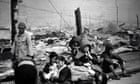
Not even the passage of eight decades has dulled Shizuko Nishio’s recollection of the night when American bombers unleashed destruction on her city. In the early hours of March 10, 1945, approximately 300 B-29 Superfortress bombers dropped 330,000 incendiary devices on Tokyo, resulting in an estimated 100,000 civilian deaths. This attack claimed more lives than the atomic bombing of Nagasaki later that year. As survivors prepare to commemorate the 80th anniversary of this tragedy, the Tokyo firebombing—considered the worst conventional bombing of World War II—remains largely overlooked.
### A Night of Horror
The night before the air raid, Nishio, now 86, was excited about her sixth birthday and the start of primary school. However, as she slept, air raid sirens blared. “My father told us to flee to the primary school in front of our house,” Nishio recalled. The school’s shelter was already full, prompting Nishio and her mother to seek refuge in another school basement, leaving behind her cousin and a nurse. The next day, they were among the charred remains of 200 people who perished in the first shelter as fires engulfed the area. Nishio was the sole survivor from her kindergarten class of 20 children.
### The Scale of Destruction
The B-29s deployed cluster bombs filled with napalm, designed to incinerate traditional Japanese wooden and paper homes in the densely populated Shitamachi district. The bombing obliterated 41 square kilometers (16 square miles) of Tokyo, transforming the city into a raging inferno and displacing 1 million residents.
### A Forgotten Tragedy
Despite the significant loss of life, the Tokyo firebombing has been overshadowed by the atomic bombings of Hiroshima and Nagasaki, relegating it to the shadows of Japan’s collective memory. Successive governments have largely ignored this event, even though it marked a critical escalation in the United States’ military strategy against Japan. U.S. Air Force General Curtis LeMay ordered low-altitude incendiary attacks aimed at destroying entire cities, with civilians becoming a deliberate target.
### The Ongoing Impact
Yoshiaki Tanaka, a professor at Senshu University, notes that many survivors continue to grapple with trauma and survivor’s guilt. “Many still experience severe trauma,” he states, having met over 100 survivors in the past decade.
As the 80th anniversary approaches, some survivors are making a final effort to gain recognition for the Tokyo firebombing, seeking acknowledgment of its profound impact on their lives and history.
**Conclusion:** How can we ensure that the memories of the Tokyo firebombing are preserved and recognized in history?
**FAQs:**
**Q: What was the impact of the Tokyo firebombing on civilians?**
A: The Tokyo firebombing resulted in an estimated 100,000 civilian deaths and left 1 million people homeless, marking it as one of the deadliest air raids in history.