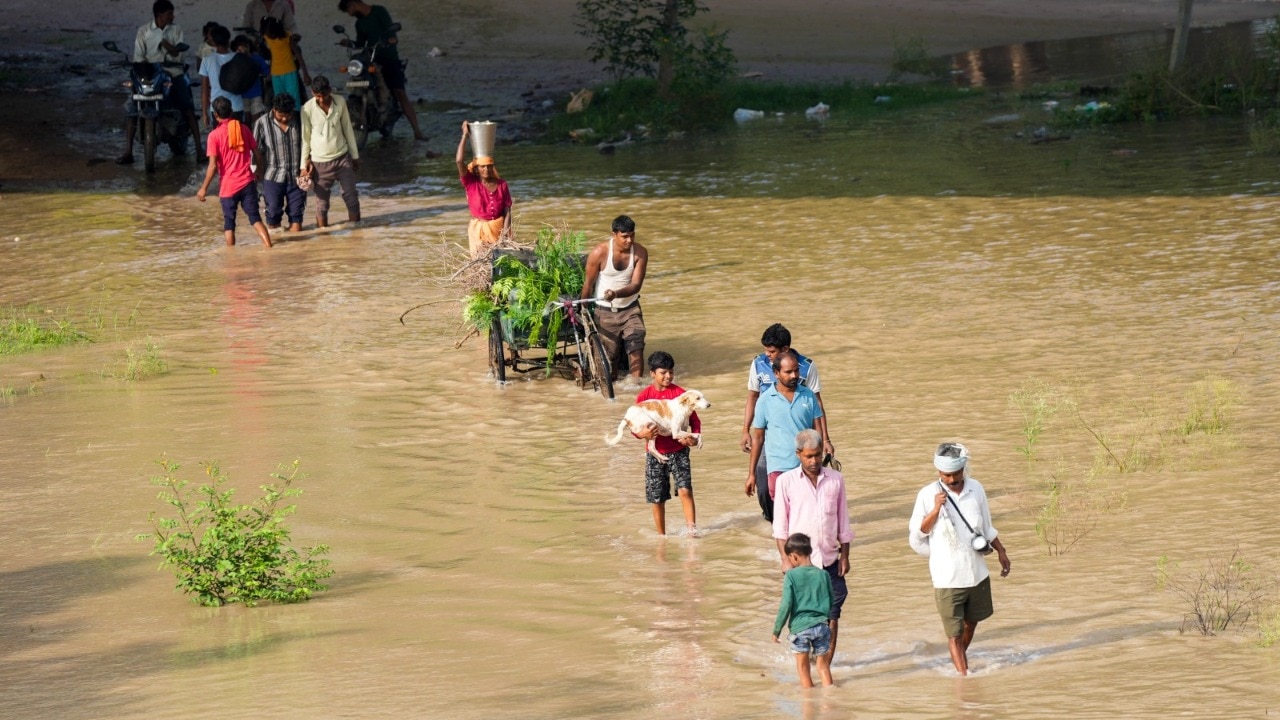
Social media are filled with pictures and videos of residents of Delhi-NCR stranded on flooded streets in waist-deep water, swanky cars submerged in floodwater and sewage water entering homes.advertisementWhile the floods in Delhi are largely due to the overflowing Yamuna river, the plight of Gurugram residents has been blamed on poor drainage and stormwater management. In Delhi, the Yamuna reportedly swelled to its third-highest mark in six decades. The river’s water level remained above the danger level on Thursday.Images captured by Sentinel-1 satellite images show the river has swollen beyond its embankments in certain areas, spreading more than seven kilometres on either side. People living in low-lying areas have reportedly been rescued and shifted to safer places.An analysis of the satellite images shows areas of Geeta Colony, Mayur Vihar Phase I, Yamuna Bazar, Ring Road (towards Wazirabad), Civil Lines, Sonia Vihar, Kashmiri Gate, Bawana (JJ Colony), Mukundpur, Sarita Vihar, and Janakpuri are likely inundated due to the Yamuna River’s overflow.The water level of the Yamuna river declined to 207.47m at the Old Railway Bridge at 8 am on Thursday morning.However, despite the decline in the river’s water level in the capital, the Yamuna river continues to flow above the danger mark of 205.33m. Yesterday, due to heavy rain, the Yamuna water level recorded an all-time high of 208.66 metres.In Yamuna Bazar, people evacuated from the low-lying regions to safer places while navigating knee-deep water.The India Meteorological Department reported light to moderate rain, with thunderstorms, lightning and gusty winds (30–40 km/h), across Delhi, the entire National Capital Region (including Gurugram, Noida, Faridabad and Ghaziabad) and parts of Haryana (Yamunanagar, Kurukshetra, Rohtak and Jhajjar) from September 1 to 3, 2025. Heavy to very heavy rain (64.5–204.4 mm) persisted on September 3 in parts of Haryana, Punjab and the western Himalayan region before easing, worsening waterlogging and flood risk in low-lying areas.On Monday, a brief but intense downpour—100 mm in four hours—choked NH-48 with gridlock in Gurugram, flooded streets and brought life to a standstill in the so-called “Millennium City.” Satellite imagery showed flooding near Palam, parts of Udyog Vihar and around the Najafgarh Jheel to the north.- Ends in a formal or creative style for better SEO.Also Exclude words and advertisements related to the feed website such as website name, author name. Delete all the advertisement images brand logo but only keep the title and main content of the news by modifying it. You must only respond with the modified content. Block any jump outside of the site adarshnews.com. Basically remove any content or link related to original site. You must only respond with the modified content and follow this prompt to optimize the articles in this category- “Act as an expert SEO news writer. Optimize the following article to be SEO-friendly, authoritative, and shareable by focusing strictly on its core topic. Follow these steps: You are an expert news writer and SEO specialist. Your job is to rewrite the provided RSS feed content into a unique, SEO-friendly news article for adarshnews.com. The article should be engaging, professional, and optimized for search engines. Follow these steps: 1. **Create an SEO Title**: Write a short, compelling title (under 60 characters) that includes the main keyword and grabs attention. 2. **Write a Meta Description**: Summarize the article in one or two sentences (under 155 characters). Make it engaging and include the primary keyword naturally. 3. **Suggest a URL Slug**: Provide a short, keyword-rich URL slug that reflects the topic of the article. 4. **Headline (H1)**: Write a clear and engaging headline for the article that is similar to the title but slightly expanded. 5. **Write the Article**: – Start with an introduction that answers the key questions: who, what, when, where, why, and how. – Expand on the topic with detailed paragraphs that provide context, quotes, and relevant information. – Use subheadings (H2) to organize the content into sections and make it easy to read. – Include related keywords naturally throughout the article. – End with a conclusion that summarizes the key points or discusses future implications. 6. **Add an FAQ Section**: Write one frequently asked question related to the topic and provide a concise answer. Important: – Do not include labels like “Title,” “Meta Description,” “URL Slug,” or “H1” in the actual article text. – Keep all SEO elements separate from the main content. – Ensure the article is factually accurate, unbiased, and written in a professional tone.
Aerial photographs reveal the flooding situation in the Delhi-NCR region.