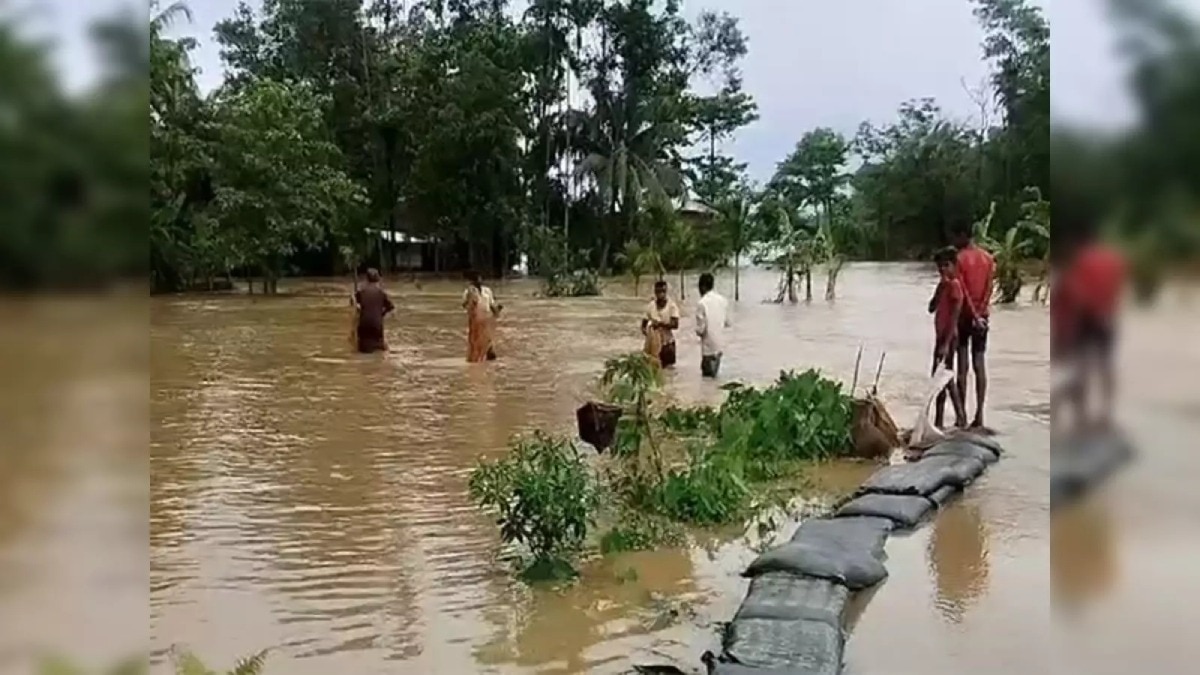
Eight persons have been killed in floods and landslides in Assam as incessant rainfall caused massive inundation in 17 districts, affecting over 78,000 people, officials said on Saturday.Three districts in the western part of the state remained on ‘red alert’ and eight more were on ‘orange alert’, as per Regional Meteorological Centre (RMC) data, while rainwaters from upstream areas of Arunachal Pradesh and Meghalaya aggravated the flood situation in the state.advertisementThe Assam State Disaster Management Authority (ASDMA) said landslides claimed five lives, all in Kamrup Metropolitan district.Massive waterlogging was reported in Guwahati with many localities remaining submerged for the second day with rescue personnel shifting stranded people to safer places as residents abandoned their waterlogged houses with no water or power supply.Urban Affairs Minister Jayanta Malla Baruah and top officials inspected the situation in different parts of the city to assess the prevailing situation and review the government’s emergency response measures.Video of a person being taken for the last rites on a banana stem shaft from his residence amidst knee-deep waters from Rukminigaon area of the city led to sharp criticism among the citizens of the government’s flood control measures.The local resident had reportedly died in his house and the family had to arrange for a shaft to take the body out to a dry place for it to be taken to the cremation ground.advertisementFloods claimed three lives, including two in Golaghat and one in Lakhimpur.A total of 17 districts were affected by the floods, including five by ‘urban floods’.The flood-hit districts were Dhemaji, South Salmara, Lakhimpur, Dibrugarh, Golaghat, Darrang, Nagaon, Karbi Anglong, Kamrup, Biswanath, Tinsukia and Karbi Anglong West.More than 58,000 people have been affected, while 1,224 flood-hit people have taken shelter in five relief camps. Another 11 relief distribution centres are also functional.Lakhimpur is the worst-hit district with more than 41,600 people affected.Multiple agencies, including NDRF, SDRF, police and fire and emergency services personnel, were pressed into relief and rescue operations with people evacuated to safety from flood-affected areas.Embankments were breached or affected in seven places, besides damage caused to infrastructure, including houses, roads and bridges in different parts, the ASDMA bulletin said.The ‘urban flood’ affected districts are Kamrup, Dibrugarh, Darrang, Cachar and Kamrup Metropolitan, the bulletin said.Nearly 21,000 people have been hit by urban floods, with the highest number of affected people in Cachar district at 12,300.Almost all the major rivers across the state were on a ‘rising’ water level trend, as per ASDMA information.The Brahmaputra was flowing near the danger level in Dibrugarh, Ranganadi in Lakhimpur, Dhansiri in Numaligarh, Jia Bharali in Sonitpur, Kopili in Kampur and Beki in Barpeta.advertisementAs per the latest RMC data, Dhubri, in a formal or creative style for better SEO.Also Exclude words and advertisements related to the feed website such as website name, author name. Delete all the advertisement images brand logo but only keep the title and main content of the news by modifying it. You must only respond with the modified content. Block any jump outside of the site adarshnews.com. Basically remove any content or link related to original site. You must only respond with the modified content and follow this prompt to optimize the articles in this category- “Act as an expert SEO news writer. Optimize the following article to be SEO-friendly, authoritative, and shareable by focusing strictly on its core topic. Follow these steps: You are an expert news writer and SEO specialist. Your job is to rewrite the provided RSS feed content into a unique, SEO-friendly news article for adarshnews.com. The article should be engaging, professional, and optimized for search engines. Follow these steps: 1. **Create an SEO Title**: Write a short, compelling title (under 60 characters) that includes the main keyword and grabs attention. 2. **Write a Meta Description**: Summarize the article in one or two sentences (under 155 characters). Make it engaging and include the primary keyword naturally. 3. **Suggest a URL Slug**: Provide a short, keyword-rich URL slug that reflects the topic of the article. 4. **Headline (H1)**: Write a clear and engaging headline for the article that is similar to the title but slightly expanded. 5. **Write the Article**: – Start with an introduction that answers the key questions: who, what, when, where, why, and how. – Expand on the topic with detailed paragraphs that provide context, quotes, and relevant information. – Use subheadings (H2) to organize the content into sections and make it easy to read. – Include related keywords naturally throughout the article. – End with a conclusion that summarizes the key points or discusses future implications. 6. **Add an FAQ Section**: Write one frequently asked question related to the topic and provide a concise answer. Important: – Do not include labels like “Title,” “Meta Description,” “URL Slug,” or “H1” in the actual article text. – Keep all SEO elements separate from the main content. – Ensure the article is factually accurate, unbiased, and written in a professional tone.
Assam floods have resulted in 8 fatalities and impacted more than 78,000 individuals across 17 districts due to intense rainfall.