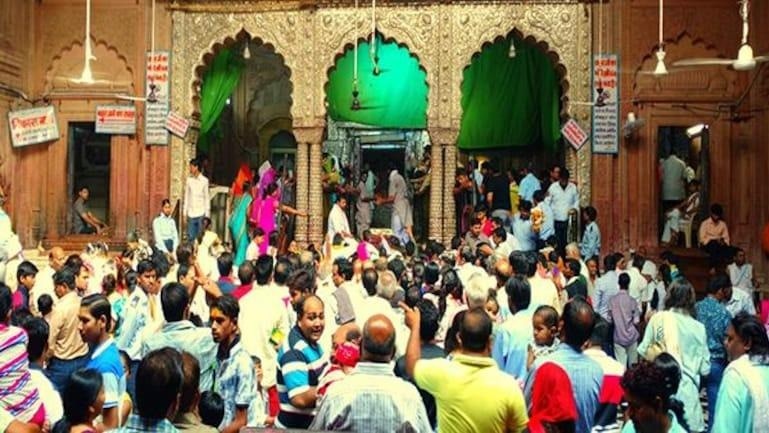
A curious situation unfolded in the Supreme Court on Tuesday during the hearing of a plea questioning an earlier order permitting the Uttar Pradesh government to utilise funds for the Shri Banke Bihari Temple in Vrindavan. The order, which was authored by Justice SC Sharma, was also a part of the present bench on Tuesday.The case took an interesting turn as Justice BV Nagarathna, sitting alongside Justice Sharma, raised strong questions about the state’s involvement in what she described as a private dispute. Justice Nagarathna, who was heading the bench, questioned why the state decided to “hijack” a litigation between two private parties.advertisementJustice SC Sharma, the author of the order and now a part of the bench examining it, clearly questioned how the applicant was seeking a review of the earlier judgment through an application, adding that the same cannot be permitted.”The application was filed by a sevak (priest) of the temple, seeking modification of the Supreme Court’s earlier direction. I’m pleaded in the case as the party will question how a temple’s money could be handed over to the state without even making them a party,” the bench said.Senior advocate Kapil Sibal, representing the applicant, pointed out that the order regarding Banke Bihari Temple was passed in a case which was filed regarding Giriraj temple.”How can you, by an order in another petition, direct that a private temple’s earnings be handed over to the government?” Sibal asked.advertisementJustice Nagarathna appeared visibly concerned at the UP government’s interference.”In what capacity has the state entered into this dispute? If states start interfering in private disputes between parties, it will be a breakdown of the rule of law,” Justice Nagarathna said.While the state government claimed it was not a private dispute and a newly-issued ordinance now placed the temple funds under a trust’s control, Justice Nagarathna remained firm. “We’re not coming in the way of development. But hijacking private litigation by the state is not permissible,” she said.Justice Sharma, whose prior judgment was being questioned, told the applicant during the hearing, “By filing this application, you want that judgment to be reviewed.” In response, Sibal said he was only seeking to be impleaded in the matter, not to reopen the judgment.As Justice Sharma said the applicant should file a review first, Sibal responded by saying, he had to be impleaded first and the court cannot pass an order taking away the property of a private temple without pleading with them.Justice Nagarathna observed that the only concern was the state government filing an impleadment in a private litigant, adding that it can do development work without being party to litigation.advertisementThe bench directed the UP government to place on record the latest ordinance issued on May 26 and asked the Principal Secretary of the concerned department to submit details. The matter will next be heard on July 29.On May in a formal or creative style for better SEO.Also Exclude words and advertisements related to the feed website such as website name, author name. Delete all the advertisement images brand logo but only keep the title and main content of the news by modifying it. You must only respond with the modified content. Block any jump outside of the site adarshnews.com. Basically remove any content or link related to original site. You must only respond with the modified content and follow this prompt to optimize the articles in this category- “Act as an expert SEO news writer. Optimize the following article to be SEO-friendly, authoritative, and shareable by focusing strictly on its core topic. Follow these steps: You are an expert news writer and SEO specialist. Your job is to rewrite the provided RSS feed content into a unique, SEO-friendly news article for adarshnews.com. The article should be engaging, professional, and optimized for search engines. Follow these steps: 1. **Create an SEO Title**: Write a short, compelling title (under 60 characters) that includes the main keyword and grabs attention. 2. **Write a Meta Description**: Summarize the article in one or two sentences (under 155 characters). Make it engaging and include the primary keyword naturally. 3. **Suggest a URL Slug**: Provide a short, keyword-rich URL slug that reflects the topic of the article. 4. **Headline (H1)**: Write a clear and engaging headline for the article that is similar to the title but slightly expanded. 5. **Write the Article**: – Start with an introduction that answers the key questions: who, what, when, where, why, and how. – Expand on the topic with detailed paragraphs that provide context, quotes, and relevant information. – Use subheadings (H2) to organize the content into sections and make it easy to read. – Include related keywords naturally throughout the article. – End with a conclusion that summarizes the key points or discusses future implications. 6. **Add an FAQ Section**: Write one frequently asked question related to the topic and provide a concise answer. Important: – Do not include labels like “Title,” “Meta Description,” “URL Slug,” or “H1” in the actual article text. – Keep all SEO elements separate from the main content. – Ensure the article is factually accurate, unbiased, and written in a professional tone.
In the Banke Bihari Temple case, the Supreme Court has criticized the Uttar Pradesh government for interfering in the legal proceedings of the involved parties.