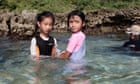
A dozen enthusiastic 10-year-olds are bouncing in their seats. The small classroom is adorned with racks of wetsuits and water gear, along with posters of turtles. However, the students’ attention is focused on their teacher, Tseng Ching-ming, as he explains the currents and sea conditions at nearby Banana Bay, where they will soon venture. “Today, you have one mission: to remove your equipment and float in the water,” he announces. Some of the children smile nervously, unaware that they are part of a unique group among their peers and predecessors.
Despite the fact that most of Taiwan’s 24 million residents live near the coast and rivers, swimming proficiency is surprisingly low, and ocean safety skills are even lower. Classes like Tseng’s depend on a few dedicated individuals eager to share their passion for the sea. They face numerous challenges, including deep-rooted parental protectiveness, bureaucratic caution, the legacy of militarized coastlines, and even cultural superstitions.
Over the past decade or two, there has been a concerted effort to transform the swimming culture in Taiwan, addressing high drowning rates and missed opportunities for enjoyment. This movement has largely been driven by committed teachers, public servants, families resisting societal pressures, and one particularly “enthusiastic” president.
Tseng’s class wraps up quickly, and everyone hops into cars with a few adult supervisors. At Banana Bay, the children navigate through jagged volcanic rocks before diving into the small but choppy waves. “We don’t want to be in the classroom; we want to be in the water all the time, every day,” one young girl exclaims.
A 2010 survey by Ocean University revealed that only 44% of Taiwanese claim they can swim. This contrasts with over half of Hongkongers, around 66% of UK citizens, and 75% of Australians—figures that align closely with the global average of 76% for high-income countries.
Like Australia, Taiwan experiences stifling heat and has perilous waterways and beaches. In Australian coastal communities, learning ocean safety is deemed essential. Conversely, the prevailing attitude in Taiwan seems to be that the ocean is dangerous and should be avoided. This mindset is reflected in restrictive beach regulations and tragically higher drowning risks. In 2007, the drowning rate for Taiwanese children under 14 was reported to be three times higher than that of their Australian counterparts.
The most common reason cited for the lack of swimming culture in Taiwan is parental fear of allowing their children near water. Tseng chuckles as he recalls his first class, where skeptical parents stood on the shore, arms crossed and eyes fixed on their children. “There are fewer kids in Taiwan, so they are seen as treasures, and parents are wary of accidents,” Tseng notes, referencing Taiwan’s historically low birth rates.
A similar narrative unfolds on Xiaoliuqiu, a small island off the coast of Kaohsiung.