**Title**: Understanding Bitcoin Mempool Dynamics and Relay Policies
**Meta Description**: Explore how different relay policies impact Bitcoin’s mempool dynamics and transaction propagation across the network.
**URL Slug**: bitcoin-mempool-relay-policies
**Headline**: Analyzing the Impact of Relay Policies on Bitcoin Mempool Dynamics
In the world of Bitcoin, the mempool plays a crucial role in transaction processing and confirmation. This article delves into the dynamics of the Bitcoin relay network, particularly when nodes operate under varying relay policies. Understanding these dynamics is essential for grasping how transactions propagate through the network and reach miners for confirmation.
The Bitcoin relay network functions on a flood-fill architecture, meaning that when a node receives a transaction, it forwards it to all connected nodes, except the one from which it received the transaction. This method, while inefficient, ensures a high likelihood that transactions will eventually reach their intended destination—miners. However, when nodes implement different relay policies, the propagation of transactions can be affected.
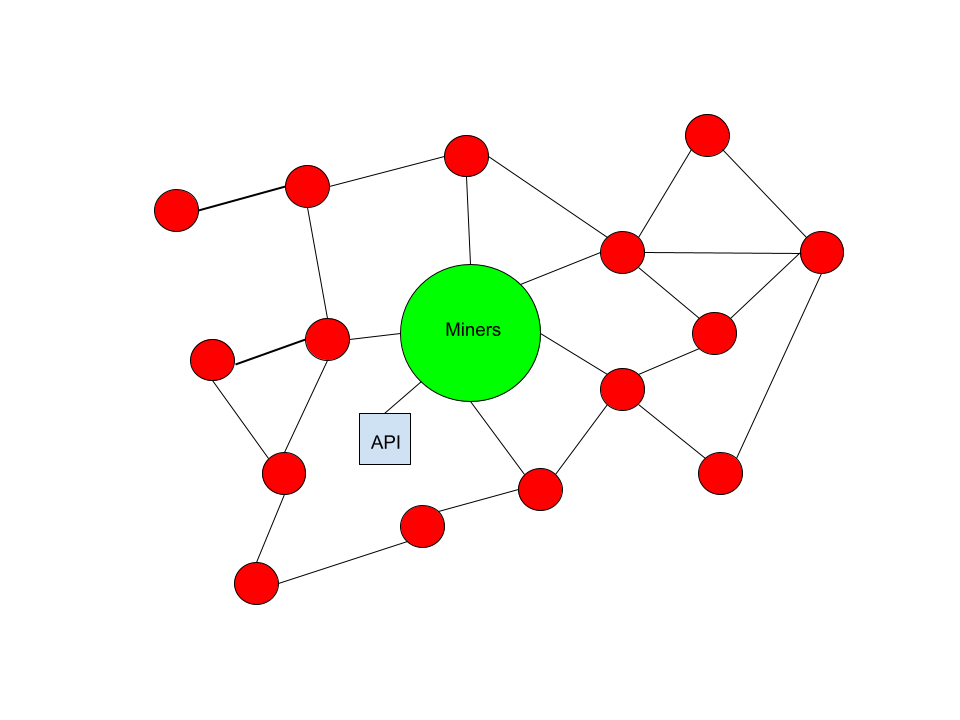
To illustrate this, consider a simplified model of a network composed of nodes with varying policies. In this scenario, blue nodes represent those that propagate a specific class of consensus-valid transactions, while red nodes do not. The miners, who are the ultimate destination for transactions, are depicted at the center. In a network where nodes refusing to propagate transactions are in the minority, the majority of nodes that accept these transactions can relay them to miners without obstruction.
Even when a significant portion of the network employs filtering policies, as shown in the example, the overall impact on transaction propagation can be minimal. Nodes that do not filter transactions still maintain clear paths to miners, allowing for continued transaction flow. This situation introduces some friction for users whose transactions are filtered, but it does not completely hinder the network’s ability to relay transactions effectively.
In conclusion, while the introduction of diverse relay policies can create friction in transaction propagation, the overall structure of the Bitcoin relay network allows for resilience. As the network evolves, understanding these dynamics will be crucial for users and miners alike.
**FAQ**
**Q: How do different relay policies affect Bitcoin transaction propagation?**
A: Different relay policies can introduce friction in transaction propagation, but as long as a majority of nodes accept and relay transactions, they can still reach miners for confirmation.