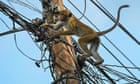
**Monkey Causes Nationwide Power Outage in Sri Lanka**
A nationwide power outage in Sri Lanka has been attributed to a monkey that entered a power station located south of Colombo. The blackout, which commenced around midday on Sunday, left many residents enduring temperatures above 30°C (86°F). Energy Minister Kumara Jayakody informed reporters, “A monkey came into contact with our grid transformer, causing an imbalance in the power system.”
Engineers worked diligently to restore electricity in the island nation of 22 million, focusing on essential services such as hospitals and water purification facilities. While some regions regained power within hours, many households without generators remained in darkness well into the night.
On social media, Sri Lankans compared the incident to a comedic scenario, with some emphasizing the vulnerability of the country’s power grid. One user remarked, “One monkey = total chaos. Time to rethink infrastructure?” Another joked, “Only in Sri Lanka can a monkey knock out the entire nation’s electricity.”
Beyond the humor circulating online, the outage highlighted Sri Lanka’s ongoing challenges with energy security. Experts have long cautioned that the country’s power grid is outdated and susceptible to disruptions. An unnamed senior engineer was quoted by the Daily Mirror, stating, “The national power grid is in such a weakened state that frequent island-wide power outages may be expected if there is a disturbance in one of our lines.”
Sri Lanka has a history of power shortages. In 2022, during a severe economic crisis, rolling blackouts became a harsh reality as fuel shortages compelled authorities to ration electricity for up to 13 hours daily. The Ceylon Electricity Board issued an apology for the Sunday blackout but did not clarify how a single incident could lead to such extensive consequences. There has been no update regarding the monkey involved.
The increasing monkey population in Sri Lanka has become a growing concern, as these animals raid villages for food and damage crops due to human encroachment on their natural habitats. The endemic toque macaque is estimated to number between 2 and 3 million on the island.