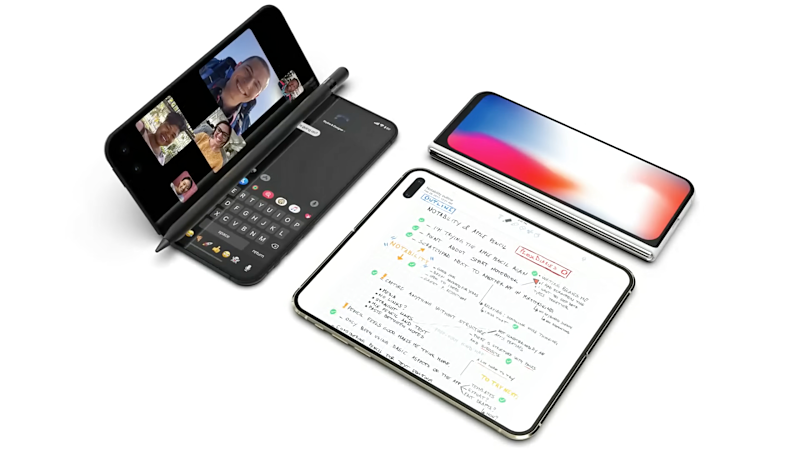
Picture the life of Samsung hardware engineers: Day after day, they toil at the cutting edge, devising almost inconceivable ways to defy physics. Components are shrunken, twisted, bent against their will. And then their work is unveiled to the world: the Samsung Galaxy Z Fold 7, an unfathomably thin folding smartphone. The company eagerly awaits the reaction of American smartphone buyers. “Meh,” they say.Harsh? Maybe. But the sales won’t lie. At this point, I don’t know what it would take for Samsung to engineer its way to a bigger slice of the US market, where Apple dominates. The consumer lock-in of iOS and the Apple product range is just too great. People love their iPhones.What an Apple foldable phone may look like.Credit: EverythingAppleProApple’s predicted upgrade “supercycle” from artificial-intelligence features has failed to materialise because they are delayed. That’s had some close observers half-heartedly questioning chief executive officer Tim Cook’s position. The billionaire can quiet at least some of that talk with the coming folding iPhone, which, according to Bloomberg News’ Mark Gurman, is expected by the end of next year. That’s a long way off but not too long. From a hardware standpoint at least, Samsung’s Fold 7 is a blueprint for where the iPhone can and will go next.The Korean giant’s foldable efforts began in 2019 with the introduction of the Galaxy Fold. The head-turning engineering achievement was held back by obvious limitations: The screen was fragile and quickly developed a prominent crease at the fold. When closed, it was rather fat — 15.5 mm. The release was delayed after reviewers found severe reliability issues. The devices have improved since, but the foldable market is still less than 2 per cent of the overall smartphone pool, CCS Insight’s Ben Wood estimates — 22 million foldable units sold in 2024.But with the Fold 7, announced at an event in Brooklyn last month, there’s more than a whiff of a suggestion that Samsung has made a foldable phone that everyday users might finally find appealing. The device has been well received in review circles. The $US2000 ($3091) price tag is huge, granted, though that can be heavily discounted with trade-ins and other perks. And again, it’s remarkably thin: When shut, the device is only six-tenths of a millimetre thicker than the latest iPhone 16 Pro.None of this alters the challenge, however, which is that anyone who might be tempted away from the iPhone has too many practical considerations that overrule the novelty or utility of a folding phone. The years of photos, videos and messages; the effortless syncing with MacBooks and iPads; the commitment to never be the one who turns the group chat green. Above all, iOS’ straightforward familiarity, and the fact that Apple has never wavered on the quality of its software, is what makes the huge majority of its customers transition from one iPhone to the next without hesitation. Switching fro in a formal or creative style for better SEO.Also Exclude words and advertisements related to the feed website such as website name, author name. You must only respond with the modified content. Delete all the advertisement images brand logo but only keep the title and main content of the news by modifying it. Block any jump outside of the site adarshnews.com. Basically remove any content or link related to original site. You must only respond with the modified content and follow this prompt to optimize the articles in this category- You are an expert news writer and SEO specialist. Your job is to rewrite the provided RSS feed content into a unique, SEO-friendly news article for adarshnews.com. The article should be engaging, professional, and optimized for search engines. Follow these steps: 1. **Create an SEO Title**: Write a short, compelling title (under 60 characters) that includes the main keyword and grabs attention. 2. **Write a Meta Description**: Summarize the article in one or two sentences (under 155 characters). Make it engaging and include the primary keyword naturally. 3. **Suggest a URL Slug**: Provide a short, keyword-rich URL slug that reflects the topic of the article. 4. **Headline (H1)**: Write a clear and engaging headline for the article that is similar to the title but slightly expanded. 5. **Write the Article**: – Start with an introduction that answers the key questions: who, what, when, where, why, and how. – Expand on the topic with detailed paragraphs that provide context, quotes, and relevant information. – Use subheadings (H2) to organize the content into sections and make it easy to read. – Include related keywords naturally throughout the article. – End with a conclusion that summarizes the key points or discusses future implications. 6. **Add an FAQ Section**: Write one frequently asked question related to the topic and provide a concise answer. Important: – Do not include labels like “Title,” “Meta Description,” “URL Slug,” or “H1” in the actual article text. – Keep all SEO elements separate from the main content. – Ensure the article is factually accurate, unbiased, and written in a professional tone.
Apple’s $3000 foldable iPhone might ease the pressure on its billionaire CEO.